
Introduction
Ethan Muse’s five-hour interview with Matt Fradd is a sight to behold: a rigorous, detailed, and entertaining defense of three Catholic miracle claims that, in Ethan’s mind, are clear demonstrations of Catholic claims about being the true religion and true Church. I agree, and I strongly recommend a full listen through of the podcast. Yet, Arthur Greenwood, an interesting Anglican history/philosophy YouTuber, has a different perspective. His argument, unlike those of skeptics like Scott Alexander or Sean Luke, does not center on providing a materialist or demonic account of Fatima, Padre Pio, and the Eucharistic miracle at Lanciano. Rather, he accepts the miracles as evidence for Christianity and nothing more:
Note - I used AI to procure a transcript of the video so I didn’t need to type it up by hand. I manually removed “uh” and “uhm” and cleaned up his sentences somewhat for readability. I do not substantially change any statement he makes in the video.
I am happy to hear that Mary appeared to shepherd children in Portugal and gave them prophecies. I am happy to hear that a Catholic priest had the scars of Christ appear on his hands for 50 years. I’m happy to hear about people being resurrected in the name of Mary via the intercession of saints because, guess what? Anglicans believe in all that stuff.
Greenwood’s argument, as I understand it, is that these miracles do not validate Catholicism, and that God had other independently motivated reasons for causing these miracles to occur in Catholic contexts. Now Greenwood does agree that these miracles would invalidate a certain kind of low church Protestantism, one that is anti-Catholic:
This is the paradox that often happens where, you know, the low church Protestants, the non-denom strip mall church kind of people, duke it out with the Catholics all day. And so, they both construct all these arguments against each other, but they don't quite know what to do when they run into someone like me, who is a Protestant, in that I'm not Catholic. I don't believe that the Pope is infallible ex cathedra, and yet I also don't think the Pope is the Antichrist. I think the Pope is a great guy. I think the Catholic Church is a force for good. I believe in intercession of the saints. I believe in praying the rosary. I believe in Mary being more than just some random woman. So, the arguments that the non-denoms make against Catholics don't quite work against Anglicans, and the arguments that Catholics make against non-denoms don't quite work against Anglicans.
In other words, these miracles invalidate a certain class of anti-Catholic evangelicals, but cannot validate Catholicism against a pro-Marian, pro-rosary, semi-pro-Pope kind of Anglican. What is the Catholic to say in response to this?
The answer I will come to at the end of this article can be summarized as such:
God works miracles everywhere, but he works doctrinally vindicatory miracles in Catholicism.
This answer will help us understand the question posed by another great creator, Caleb Jackson.
Here, Caleb presents the resurrection of Daniel Ekechukwu as a kind of tu quoque, though I hardly think he is being fallacious. He poses a serious question: might there be other vindicatory miracles among other religions? If so, what do we do to adjudicate?
Now that I have reached the end of this lengthy introduction, I will address Arthur and Caleb in turn, and hopefully both answers will play off of one another in a way that gives a good heuristic for thinking about miracle claims and vindicatory miracles.
Miracles and Vindicatory Miracles
If I'm right that God doesn't really care about denominations, then what we're seeing is exactly what we would predict. Because if God doesn't care about denominations, then we would see a few miracles in every denomination. And sure enough, that's what we see. There are Anglican miracles. There are miracles in the Coptic Church, as we talked about earlier, this Marian apparition that Muslims, atheists, communists, everyone sees.
- Arthur Greenwood, 3 Miracles That PROVE Christianity
The primary distinction which must be established first is the distinction between what we might call an “ordinary miracle” and a “vindicatory miracle”. Christians should all accept that God expresses a kind of common love to all creatures, one that permits him to do miraculous healings and other wonders in a variety of different contexts. In Question 178, Article 2 of the Secunda Secundæ Partis, St. Thomas Aquinas writes:
True miracles cannot be wrought save by the power of God, because God works them for man’s benefit, and this in two ways: in one way for the confirmation of truth declared … On the first way miracles can be wrought by any one who preaches the true faith and calls upon Christ’s name, as even the wicked do sometimes. On this way even the wicked can work miracles. Hence Jerome commenting on Matthew 7:22, “Have not we prophesied in Thy name?” says: “Sometimes prophesying, the working of miracles, and the casting out of demons are accorded not to the merit of those who do these things, but to the invoking of Christ’s name, that men may honor God, by invoking Whom such great miracles are wrought.”
In this way, we see that God can perform miracles in context where there is recognition of Christ and the true faith. Therefore, God rewards this recognition of truth with a miracle, but does not affirm other actions or beliefs of the individual who receives the miracle. If all miracles vindicated the person who received them, then it would become impossible to distinguish the true Church from a false one, something which God obviously doesn’t want.
But sometimes, God does want to vindicate someone and he does use miracles to do it. Thus Paul says in 2nd Corinthians 12:12:
The signs of a true apostle were performed among you with utmost patience, with signs and wonders and mighty works.
So Paul can vindicate his own apostolic authority via miracles. By what means can we distinguish these vindicatory miracles from non-vindicatory ones? Aquinas answers this in Article 1 of the same question:
… so too the word uttered needs to be confirmed in order that it be rendered credible. This is done by the working of miracles, according to Mark 16:20, "And confirming the word with signs that followed": and reasonably so. For it is natural to man to arrive at the intelligible truth through its sensible effects. Wherefore just as man led by his natural reason is able to arrive at some knowledge of God through His natural effects, so is he brought to a certain degree of supernatural knowledge of the objects of faith by certain supernatural effects which are called miracles.
On Aquinas’ account, God validates the words of his messengers with prophecies. And this is shown in the Biblical account of miracles as well. Deuteronomy 18 records:
18 I will raise up for them a prophet like you from among their brothers. And I will put my words in his mouth, and he shall speak to them all that I command him. 19 And whoever will not listen to my words that he shall speak in my name, I myself will require it of him. 20 But the prophet who presumes to speak a word in my name that I have not commanded him to speak, or who speaks in the name of other gods, that same prophet shall die.’ 21 And if you say in your heart, ‘How may we know the word that the Lord has not spoken?’— 22 when a prophet speaks in the name of the Lord, if the word does not come to pass or come true, that is a word that the Lord has not spoken; the prophet has spoken it presumptuously. You need not be afraid of him.
So if a prophet (a) speaks in the name of the Lord and (b) speaks a word that comes to pass or comes true (prophecy), that is a prophet who can be trusted. This is especially important for the validation of Jesus as the prophet like Moses, and Jesus himself employs these criteria in dealing with the Jews who doubted him:
24 So the Jews gathered around him and said to him, “How long will you keep us in suspense? If you are the Christ, tell us plainly.” 25 Jesus answered them, “I told you, and you do not believe. The works that I do in my Father’s name bear witness about me …
In sum, an ordinary miracle can be distinguished from a vindicatory miracle inasmuch as ordinary miracles affirm basic truths of shared Christian faith (the existence of the one God, the Lordship of Jesus Christ, or the healing power of the Holy Spirit) while vindicatory miracles affirm a deeper doctrinal message (where the true Church is, devotion to Mary, theology of communion). In this case, we would expect (and do find) miracles all over the broad spectrum of Christian denominations. But we would only expect to find vindicatory miracles in one denomination in particular. In a certain sense, all miracles are vindicatory of something doctrinal, but our concerns for this article are those miracles which pertain to disputed Christian doctrine.
To be clear here, I am making a couple of assumptions in my reasoning. First, I am assuming that when the Bible provides certain criteria for discerning true messengers of God, these criteria are true. I am also assuming that all of the miracles I discuss are authentic: not naturally explicable and not demonic. Since all of the miracles mentioned here pertain to proclaiming Jesus, we can assume (for the time being) we are not dealing with demonic activity.1 Finally, I am assuming some kind of “mere Christianity” is true, probably best represented in the Nicene Creed.
Greenwood’s Errors
With these preliminary definitions in place, we can now respond to Arthur’s video. In short, Arthur (without attributing ill intent) seems to almost completely ignore the vindicatory nature of these miracles. He does address it at some level, asking rhetorically:
The question is, is this evidence for Catholicism? Because if Anglicanism is true, then how come these miracles are appearing in a Catholic context? How come Catholics are the ones seeing these miracles? Why shouldn't these things be happening in England? And also isn't Catholicism an evil false religion? So, you know, why would Mary when she came down in Portugal not say, "By the way, everyone, the Pope is a liar. The Pope is the Antichrist." I'm kind of making the answer obvious: because I don't believe the Pope is the Antichrist. I don't believe the Pope is a bad person.
Ironically, it seems it is Arthur here who is committing a kind of false dichotomy. He insists that the Evangelicals and Catholics are the ones who assume there is a sharp line between Protestant and Catholic distinctives about the Pope. But he is the one who does so in assuming that either Mary would be entirely positive about the Pope, or entirely negative. This is an incomplete analysis. Instead we must ask: are the miracles which occurred at Fatima, at Lanciano, and to Padre Pio vindicatory of something other than the shared faith of Anglicans and Catholics?
Fatima
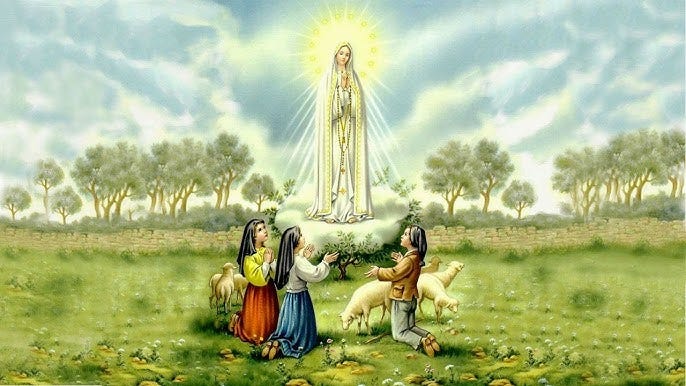
As has been shown in the preceding section, signs can accompany teaching to affirm the teachings given. In the case of Fatima, there are four specific “teachings” which we care about for the sake of this investigation: the vision of the angel, and the three secrets2 revealed by Mary to the shepherd children at Fatima. Remember that we are taking these as given, as this is an internal critique of Arthur’s view. The text of the secrets can be found here, the vision of the angel can be found in Sister Lucia’s memoir here. I assume that the reader has some familiarity with Fatima, if they do not I recommend them to listen to the Ethan Muse interview first.
The Vision of the Angel
As soon as we arrived there, we knelt down, with our foreheads touching the ground, and began to repeat the prayer of the Angel: “My God, I believe, I adore, I hope and I love You...”, I don’t know how many times we had repeated this prayer, when an extraordinary light shone upon us. We sprang up to see what was happening, and beheld the Angel. He was holding a chalice in his left hand, with the Host suspended above it, from which some drops of blood fell into the chalice. Leaving the chalice suspended in the air, the Angel knelt down beside us and made us repeat three times: “Most Holy Trinity, Father, Son and Holy Spirit, I adore You profoundly, and I offer You the most precious Body, Blood, Soul and Divinity of Jesus Christ, present in all the tabernacles of the world, in reparation for the outrages, sacrileges and indifference with which He Himself is offended. And, through the infinite merits of His most Sacred Heart, and the Immaculate Heart of Mary, I beg of You the conversion of poor sinners.”
The first apparition the children experienced was not of Mary but of an angel. This angel instructs the children to repeat a prayer which affirms the true presence of Christ in the Eucharist, specifically in what appears to be an affirmation of transubstantiation. We see that the host is bleeding, implying a physicality of Christ’s blood present in and with it. We observe that the angel and the children worship the host and chalice, kneeling before it. We also observe our first affirmation of the Immaculate Heart of Mary, which I will return to later.
We read that after the prayers are said by the children:
Then, rising, he took the chalice and the Host in his hands. He gave the Sacred Host to me, and shared the Blood from the chalice between Jacinta and Francisco, saying as he did so “Take and drink the Body and Blood of Jesus Christ, horribly outraged by ungrateful men! Make reparation for their crimes and console your God.”
The fact that this is occurring in a specifically Catholic context, and the angel is affirming to Catholic children that they are receiving the Body and Blood without qualification, can only be taken to imply that the angel is teaching transubstantiation. The angel specifically tells the children to make reparation for “their crimes” (men’s sin) through reception of the Eucharist.
By the time of even the first apparition, the children are given divine confirmation of transubstantiation, Eucharistic Adoration, the Immaculate Conception, and reparation for sin via the Eucharist. These are all clearly Catholic distinctives, and many are outright denied by the 39 Articles.
The First and Second Secret
The First Secret involved showing the children a vision of hell. I have cut the recounting of this for length. After the vision, Mary gave the Second Secret to the children. Sister Lucia writes:
We then looked up at Our Lady, who said to us so kindly and so sadly: You have seen hell where the souls of poor sinners go. To save them, God wishes to establish in the world devotion to my Immaculate Heart. If what I say to you is done, many souls will be saved and there will be peace. The war is going to end: but if people do not cease offending God, a worse one will break out during the Pontificate of Pius XI. When you see a night illumined by an unknown light, know that this is the great sign given you by God that he is about to punish the world for its crimes, by means of war, famine, and persecutions of the Church and of the Holy Father. To prevent this, I shall come to ask for the consecration of Russia to my Immaculate Heart, and the Communion of reparation on the First Saturdays. If my requests are heeded, Russia will be converted, and there will be peace; if not, she will spread her errors throughout the world, causing wars and persecutions of the Church. The good will be martyred; the Holy Father will have much to suffer; various nations will be annihilated. In the end, my Immaculate Heart will triumph. The Holy Father will consecrate Russia to me, and she shall be converted, and a period of peace will be granted to the world.
Within these apparitions, we see several doctrines clearly established: intercession of the saints (specifically Mary appearing and asking for prayers for her intercession), the Immaculate Heart, the first Saturday devotion, and the good of Eastern Orthodox conversion to Catholicism, and the Papacy being connected with the true Church. Of course, Mary does not explicitly exposit the teachings of Vatican I, but she does associate “the Holy Father” with “the Church.” Towards the end, she says that Russia (if her requests are not heeded) will spread war and persecutions of the Church. What are these wars and persecutions?
The good will be martyred; the Holy Father will have much to suffer; various nations will be annihilated.
So the persecution of the Church will involve the suffering of the Holy Father, the Pope. That seems to pretty clearly imply the Holy Father is the leader of the Church. Further evidence of this is what she says will happen if the Holy Father consecrates Russia to her Immaculate Heart:
The Holy Father will consecrate Russia to me, and she shall be converted, and a period of peace will be granted to the world.
Russia will be converted. Converted to what? The meaning of the text can only make sense if the conversion is to Catholicism. Notice that Our Lady says this conversion will occur whether or not Russia spreads her errors (communist uprising). Therefore the conversion is not to apostolic Christianity generally but to Catholicism specifically.
The Third Secret
After the two parts which I have already explained, at the left of Our Lady and a little above, we saw an Angel with a flaming sword in his left hand; flashing, it gave out flames that looked as though they would set the world on fire; but they died out in contact with the splendour that Our Lady radiated towards him from her right hand: pointing to the earth with his right hand, the Angel cried out in a loud voice: 'Penance, Penance, Penance!'. And we saw in an immense light that is God: 'something similar to how people appear in a mirror when they pass in front of it' a Bishop dressed in White 'we had the impression that it was the Holy Father'. Other Bishops, Priests, men and women Religious going up a steep mountain, at the top of which there was a big Cross of rough-hewn trunks as of a cork-tree with the bark; before reaching there the Holy Father passed through a big city half in ruins and half trembling with halting step, afflicted with pain and sorrow, he prayed for the souls of the corpses he met on his way; having reached the top of the mountain, on his knees at the foot of the big Cross he was killed by a group of soldiers who fired bullets and arrows at him, and in the same way there died one after another the other Bishops, Priests, men and women Religious, and various lay people of different ranks and positions. Beneath the two arms of the Cross there were two Angels each with a crystal aspersorium in his hand, in which they gathered up the blood of the Martyrs and with it sprinkled the souls that were making their way to God.
Regardless of the fulfillment of this prophecy (Sister Lucia and John Paul II both agree that the assassination attempt on John Paul II did fulfill the prophecy), we see here again a particular concern with the Pope. We also see concern with men and women in the religious life. Once again, there seems to be a very explicit teaching of the Pope as representative of the whole church. Notice that it is the Pope who is shot first, and then after him other members of the clergy, then those in religious life, then various lay people. Once again, we don’t see explicit affirmation of Vatican I. But we do see a very positive outlook on the Pope and what obviously is a vision of him being representative of the whole Church.
Do the Apparitions Contradict Anglicanism?
One of the difficulties I have encountered in writing this article is that defining “Anglicanism” is a rather difficult task. It was actually a surprise when I found out that the Church of England no longer requires adherence to the 39 Articles, the distinctive Anglican text of the reformation. Stranger still, members of the Global Anglican Future Conference (GAFCON, a hilarious acronym), affirm in their Jerusalem Statement that “We uphold the Thirty-nine Articles as containing the true doctrine of the Church agreeing with God’s Word and as authoritative for Anglicans today,” while also affirming that “while acknowledging the nature of Canterbury as an historic see, we do not accept that Anglican identity is determined necessarily through recognition by the Archbishop of Canterbury.” Putting aside the obvious apologetic difficulties in defending a church where members cannot even agree if your founding documents are binding on members, and putting aside the difficulties in even defining Anglicanism if those self-identified Anglicans cannot even agree if recognition of the Archbishop of Canterbury is a necessary feature of Anglican identity, we can still use the apparitions to dispute core teachings of Anglicanism.
To do so, I will distinguish between Confessional and Jurisdictional Anglicanism, and show how Fatima contradicts both. Now I am sure that there is some Anglican out there who will insist they are a part of an Anglican Church which meets neither the criteria for Confessional or Jurisdictional Anglicanism. But in truth, I think the arguments I present here should cause any Anglican who does not submit to Rome to doubt their current church membership. Greenwood himself seems to adhere to a kind of Jurisdictional Anglicanism.
Confessional Anglicanism
I will define Confessional Anglicanism as Anglicanism which requires adherence to the 39 articles. Here, Fatima stands in direct contradiction to the 39 articles.
The first apparition presents the angel and the children adoring the Eucharist, which is presented in a transubstantiated form. The angel affirms that the Eucharist is truly the body, blood, soul, and divinity of Christ and tells the children to offer it up and receive it in reparation for sin.
This runs directly contrary to Anglican distinctives presented in the 39 Articles, specifically article XXV:
The Sacraments were not ordained of Christ to be gazed upon, or to be carried about, but that we should duly use them.
And article XXVIII:
Transubstantiation (or the change of the substance of Bread and Wine) in the Supper of the Lord, cannot be proved by holy Writ; but is repugnant to the plain words of Scripture, overthroweth the nature of a Sacrament, and hath given occasion to many superstitions.
The Body of Christ is given, taken, and eaten, in the Supper, only after an heavenly and spiritual manner. And the mean whereby the Body of Christ is received and eaten in the Supper is Faith.
The Sacrament of the Lord’s Supper was not by Christ’s ordinance reserved, carried about, lifted up, or worshipped.
Contrary to the 39 Articles, we see the Eucharist being gazed upon, lifted up, worshipped, and presented in an entirely physical way.
This is what the children would have understood it as. Furthermore, we see yet another contradiction, this time with article XXXI:
THE Offering of Christ once made is that perfect redemption, propitiation, and satisfaction, for all the sins of the whole world, both original and actual; and there is none other satisfaction for sin, but that alone. Wherefore the sacrifices of Masses, in the which it was commonly said, that the Priest did offer Christ for the quick and the dead, to have remission of pain or guilt, were blasphemous fables, and dangerous deceits.
Once again, the angel tells the children to offer and receive the Eucharist as reparation for sinners. There is direct contradiction here.
Therefore, one cannot affirm the truth of the 39 Articles and also the revelations of Fatima. There is too much explicit contradiction in the nature of the Eucharist taught and the language of reparation used.
Jurisdictional Anglicanism
Jurisdictional Anglicanism is membership in a church which descends from the English Reformation and the Church of England, practices in the Prayer Book tradition, and is in communion with the Archbishop of Canterbury. In addressing such a position, we must take the fundamental view that God desires, as a function of his permissive will, every man to know what church is the true church. This entails that God desires us to know what the proper Church structure is, who has authority over his Church.
So it should be a surprise if Jurisdictional Anglicanism is true that God’s messengers at Fatima seem incredibly concerned with the actions of the Pope, specifically that he would consecrate Russia to the Immaculate Heart of Mary, a doctrine only dogmatically taught in one Church. To be more clear, a crucial disagreement Arthur says he has with Catholicism is its teaching about papal infallibility:
I don't believe that the Pope is infallible ex cathedra … The problem is that the Pope was just a little bit too dogmatic about his doctrines. We have this claim that the Pope’s dogma is infallible ex cathedra. And intellectually I just don't believe those things to be true. I don't see any reason to believe those things and therefore I can't be Catholic …
And yet, we see that one of the major things that the Pope has defined ex cathedra is the Immaculate Conception by Blessed Pius IX in Ineffabilis Deus. Now is it technically possible that the Pope just so happened to be correct on the Immaculate Conception (even though no other Church teaches it dogmatically), and that Mary is simply affirming the same doctrine even though the Pope wasn’t speaking infallibly when he defined it? Sure. But even in the best case scenario for the Anglican, it would need to be a huge evidential chip in favor of the Catholic position. Another evidential chip is that, as I showed earlier, the Third Secret gives a kind of “representativeness” to the Pope. He dies first, followed by the other bishops, priests, religious, and then laity. There is an implied hierarchy in the deaths, one that seems to reflect the structure of the Catholic Church. Again, is it possible that God chose to depict the vision in this way for entirely unrelated reasons? Certainly. But at a certain point, too many evidential chips on one side must outweigh personal intellectual objections to Catholic ecclesiology.
As I already pointed out, the conditional prophecy given by Mary teaches that if the Pope consecrates Russia (at that point, an Eastern Orthodox country) to the Immaculate Heart, then Russia will convert. This condition is given regardless of if Russia has spread its errors at the time of the consecration. Now, it seems strange that God would be concerned, on any form of Anglicanism, with making an Eastern Orthodox country Catholic. Isn’t any Christian group, given the very ecumenical view of the Anglicans, a good thing for God to desire? Why does he want their Catholicity? If Catholicism is false, it seems impossible that God could actively promise more converts to a false church as a reward for that false church’s obedience. To me, this is more than an evidential chip. This is proof of Catholicism's truth.
I can anticipate one counter objection to this argument, which is that God frequently gives visions to Muslims of Jesus, and those Muslims find their way into the Church through Protestant missionaries who God tells them to go see. But I am unaware of any visionary experience a Muslim has had in which God affirms the truth of a protestant denomination or theology. God could indeed deign it better for a Muslim to become Protestant than to stay Muslim, but this would only be done through revelations of those basic truths of the shared Christian faith.
Fatima In Sum
The angel and Our Lady present a number of Catholic doctrines to the children, including a dogma infallibly declared by the Pope, emphasis of the truth of transubstantiation, and affirmation of the goodness of Eastern Orthodox conversion to Catholicism. This is insurmountable vindicatory evidence of Catholicism over other Christian sects.
Padre Pio
I lack the time and space to go into Padre Pio’s miracles in much depth here. Once again, I would refer interested listeners to the Pints interview and to Ethan Muse’s excellent article on the topic, some of which I quote from here. Padre Pio was not a prophet like the Fatima seers, but did have a strong commitment to Catholic doctrine. As Muse puts it:
If Catholicism were false, it would be very surprising that God uniquely privileged, quantitatively and qualitatively, a Catholic priest that harshly criticized Protestantism, Orthodoxy, and even liberal Catholicism with “a staggering abundance of spiritual gifts.” Fr. Schug wrote “I know of no other person in history who has had such a range of gifts encapsulated within himself or herself. There has never been anyone like him.” It is absurd not to heed the opinions of a saint that regularly communicated with Our Lord and was chosen to recapitulate His miracles, sufferings, and character more fully than anyone else in history, excepting the Holy Family.
Padre Pio also received many visions over the course of his life, many of which implicitly or explicitly affirm Catholic doctrines. Muse continues:
In his diary, St. Pio wrote “I received various inner insights about several people. I saw his Vicar on earth filled with bitterness because of the wickedness of men. Many times I was asked to pray and to encourage others to pray for him and for the repentance of these wicked souls.”
Receiving a vision from God that positively identifies Christ’s representative on earth and reveals supernatural insight about his mental state is a strong evidential chip towards Catholicism. Why did Pio not receive similar visions about the Archbishop of Canterbury?
It is also striking that God never gave Pio any instructions to be more ecumenical or accommodating given the Jurisdictional Anglican account of denominations not mattering much. Muse brings up a story in which Pio strongly encourages an Eastern Orthodox woman to convert or she will go to Hell:
When an Eastern Orthodox woman told St. Pio that “since she felt her religion was very close to the Catholic one, she understood she was too old now to change religion, especially since doing so would caused too much pain for her relatives,” he replied by asking “Do you believe your family will be there before the Lord to answer for you?” He also told her that the Orthodox Church was “dying.” The woman converted. God was giving St. Pio spiritual insights every day. Wouldn’t it have been more ‘accommodating’ to convince St. Pio to be more ecumenical?
Pio’s life and visions should be very surprising on Greenwood’s view.
On the Confessional Anglican view, the facts of Pio’s life become much more damaging evidentially. For instance, the 39 Articles reject confession as a sacrament ordained by Christ:
Those five commonly called Sacraments, that is to say, Confirmation, Penance, Orders, Matrimony, and extreme Unction, are not to be counted for Sacraments of the Gospel, being such as have grown partly of the corrupt following of the Apostles, partly are states of life allowed in the Scriptures; but yet have not like nature of Sacraments with Baptism, and the Lord's Supper, for that they have not any visible sign or ceremony ordained of God.
Yet as Muse points out:
When a penitent confessed that he “considered Confession a good institution,” but “did not at all believe in the divinity of the Sacrament,” St. Pio replied “These are all heresies, and all your communions have been sacrilegious... You must make a general Confession.” That penitent reported that St. Pio knew about sins that “humanly speaking it was impossible for the Father to know…”
So God, in conjunction with Pio’s rebuke of the sinner for not believing in confession as a Sacrament in the Catholic sense, is revealing to Pio sins which could not be known by Pio naturally.
The 39 Articles also reject purgatory:
THE Romish Doctrine concerning Purgatory, Pardons, Worshipping, and Adoration, as well of Images as of Reliques, and also invocation of Saints, is a fond thing vainly invented, and grounded upon no warranty of Scripture, but rather repugnant to the Word of God.
But as Muse recounts:
When Bishop Alberto Costa asked Padre Pio if he had ever seen a soul in Purgatory, St. Pio replied “I have seen so many that they don’t scare me anymore.” On one occasion, he told a couple of friars that “I was talking to some souls on their way from Purgatory to Paradise. They came to thank me that I remembered them today in the Mass.”
In short, one cannot believe Pio is a visionary while holding to the 39 Articles, and they would have a very hard time rejecting Catholicism given the visions he had and the activity he engaged in throughout his life.
Lanciano
Here, I will keep my discussion brief. On the Confessional Anglican view, Lanciano stands in direct contradiction to the 39 Articles, as I have already shown that they deny transubstantiation outright. As for Jurisdictional Anglicanism, I concur with Muse that it is very strange that God has chosen to cluster Eucharistic miracles in the Catholic Church. As Muse puts it:
Might the aforementioned distribution be an artifact of a selection effect? That neglects the vindicatory intent of the miracles. If God intends to use these miracles to send a message, then verification is providential. There would be no reason for him to allow his intended message to be distorted by sampling bias. To avoid giving the misleading impression that Catholicism is uniquely favored, it would be trivial for Him to arrange for the scientific verification of a Eucharistic miracle in a rival sect.
In truth, we do not observe Anglican eucharistic miracles of comparable quality or veracity, either in high or low church anglican contexts. Given the importance of the Eucharist, you would think God would desire to foster greater Eucharistic devotion among those who don’t believe in transubstantiation, but instead he chooses to only make those miracles occur among those whose churches already affirm the nature of transubstantiation.
The only miracle I can find that comes close (and the one Sean Luke brings up in his debate with Ethan), is the alleged miracle at Corpus Christi Anglican Church, where the host is said to have miraculously glowed, as seen in the photo below:
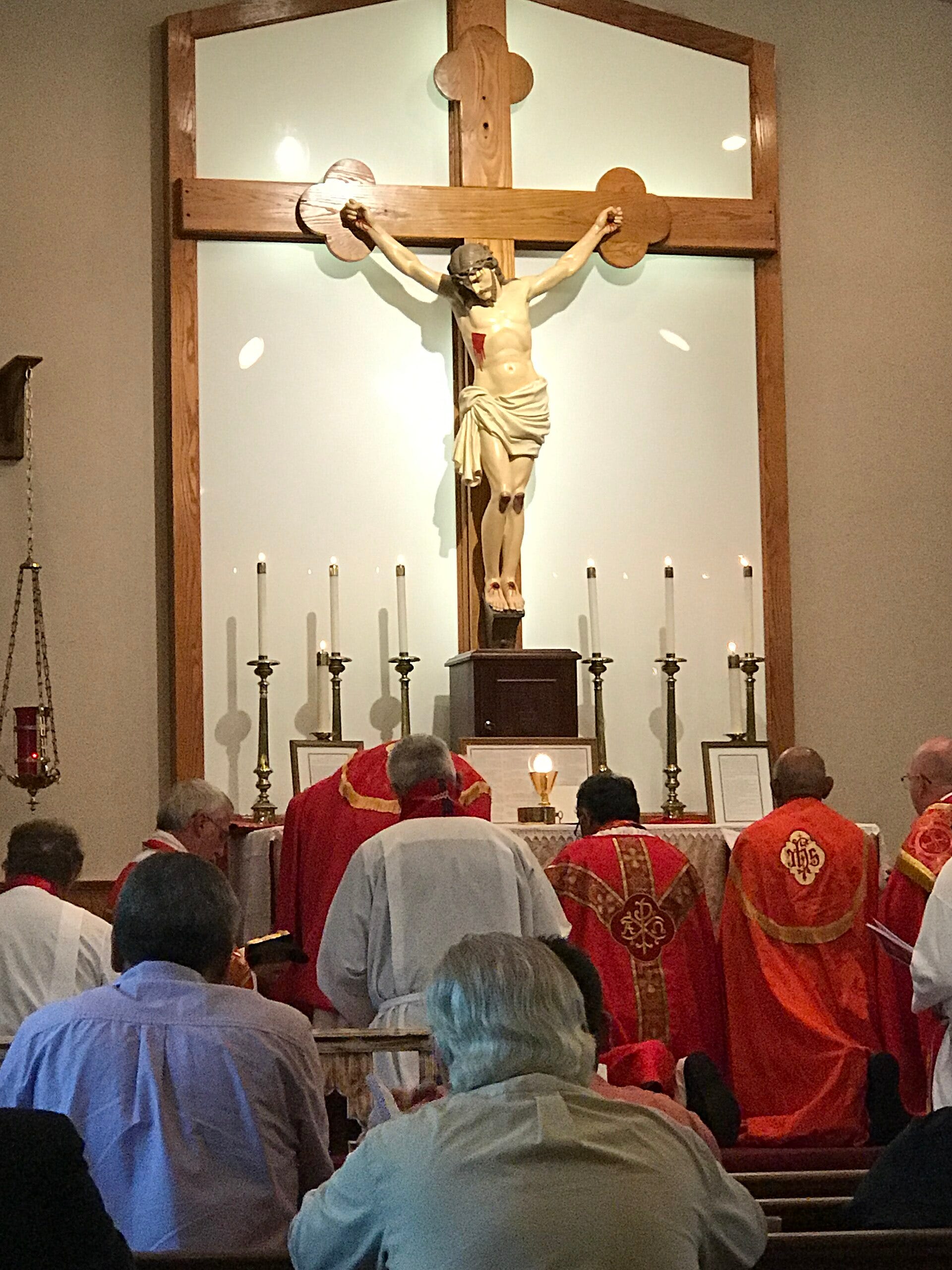
But as can be easily seen in this image, there are lights of a similar brightness which appear around the cross. These lights correspond with other images of the church that show there are round, circular lights above the altar:

The lack of comparable, verifiable Eucharistic miracles among those who affirm the real presence is striking, and provides another strong evidential chip for Catholicism.
Greenwood’s Alternative Account
Putting aside those miracles for which there seems to be a clear vindicatory element, it is also strange that there are so many more documented miracles in the Catholic Church over other churches. Why is this? Greenwood provides three reasons:
One, Catholics just are on the whole more faithful than Anglicans. If you go to somewhere like Brazil … You're going to meet a lot of very pious people who are deeply, deeply devoted to God. Whereas if you go to London, you're not. And unfortunately, as much as I think that the Anglican Church structure is the best, as much as I love the Anglican tradition, and I love C.S. Lewis … people in that church have become a lot less pious and a lot less devout than Christians are in the global south …Point B, there just numerically are a lot more Catholics than Anglicans. There are a lot more Catholics than any other Christian denomination. So, if I'm right and God doesn't care about denomination, then we would expect just as a statistical fact for most of the miracles and for the most astounding miracles to appear in a Catholic context … The third reason, which is just that the Catholics keep better records. So, there may have been all kinds of miracles in an Anglican context, but because we don't really care so much about miracles as the Catholics do and because we don't have the same system for canonization and for recording everything that happens, a lot of [miracles] would just be lost to history. There are Anglican miracles, for instance, Saint Martyr King Charles I, his handkerchief was reported uh we have, you know, eyewitness testimony of this man whose daughter was healed from blindness by touching this handkerchief with blood from Saint Martyr King Charles.
So the three explanations given are 1) more piety among Catholics than Anglicans, 2) more Catholics than Anglicans, and 3) lack of documentation among Anglicans. In response, I would argue that all three of these features of Catholicism are themselves motives of credibility which vindicate Catholic claims.
More Piety?
It is difficult to measure “piety” among competing Christian groups. However, even if Catholics are more pious than Anglicans, this would not show why Catholics seem to have more miracles of a vindicatory/message kind than any other Christian groups. Many Christian groups have had healings, but I am unaware of a single documented non-Catholic group having documented visionary experiences like the ones described at Fatima or by Padre Pio. This is in spite of the fact that there are many local denominations of pentecostals and charismatics which report alleged miracles all the time. Why are Catholics getting miracles of this particular vindicatory nature?
Furthermore, if Greenwood is right in assuming that Catholics are, on the whole, more pious (strangely, I think he is more eager to admit this than I am), this itself would serve as a motive of credibility to Catholicism. If I am trying to decide whether a potentially vindicatory miracle gives more credibility to two groups which claim it is vindicatory of their own position, the fact that one group is more pious and devout (especially as a result of that miracle) seems to be strong evidence that it is that group which is being vindicated.
More Catholics?
It is true that if God was just distributing miracles on a “share of Christian population” based system, we would expect to see more miracles in Catholic contexts since there are more Catholics than non-Catholics. But this objection, once again, ignores the distinction in the kind of miracles we are talking about. It isn’t just that Catholics are getting a bunch of healing miracles from praying for the intercession of the saints and to God, it is that we are the only Church with medically documented Eucharistic miracles. If God didn’t care about denominations much, why would he not create similar miracles, even in a smaller proportion, among non-Catholics? Non-Catholics are 50% of the Christian population, and yet the distribution of scientifically documented Eucharistic miracles are several to zero Catholics vs non-Catholics.
And again, the fact that there are so many more Catholics than other Christian groups is a motive of credibility for Catholicism. We have more adequately fulfilled the great commission than any other group. So if you were trying to decide if a vindicatory miracle is vindicatory of a particular denomination, the fact that it is happening in the denomination with loads and loads of faithful members is a strong witness to God being with that Church in a particular way.
Better Documentation?
It is certainly true that there is better documentation by Catholics than non-Catholics of our miracles, but as was already pointed out by Ethan Muse, this is simply further vindication of Catholicism:
Might the aforementioned distribution be an artifact of a selection effect? That neglects the vindicatory intent of the miracles. If God intends to use these miracles to send a message, then verification is providential. There would be no reason for him to allow his intended message to be distorted by sampling bias. To avoid giving the misleading impression that Catholicism is uniquely favored, it would be trivial for Him to arrange for the scientific verification of a Eucharistic miracle in a rival sect.
In short, God is provident over the vindication of his own miracles. If, as Greenwood claimed, God didn’t care about denomination, it is quite strange that he has placed all of the extraordinary, scientifically inexplicable, and message-based miracles in the Catholic Church.
Summing Up
Greenwood’s response fails to distinguish between the different degrees of vindication among miracles. While every Christian denomination has likely had a healing miracle in the name of Jesus at some point, the Catholic Church is the only denomination3 to have documented miracles associated with a divine messenger that preaches the denomination’s doctrines and truth associated with it. At worst, the quality and quantity of Catholic miracle claims provide an incredibly strong evidentiary weight for the Church’s truth, one that, when weighed against our own ability to sort out difficult theological topics like papal infallibility, should provide us with very strong reasons to become Catholic.
Caleb Jackson and Daniel Ekechukwu
The resurrection of Daniel Ekechukwu (hereafter just Daniel) is genuinely crazy. I recommend you all go read Caleb’s article, as I found it to be very compelling. For the sake of this article, I will assume that everything recounted in the case is true. Daniel really did die, receive a vision of heaven and hell, and was resurrected after being declared dead by multiple doctors and being embalmed. Once again, this case is insane and seems genuinely inexplicable on naturalism. Go check it out.
That said, is there a vindicatory element to this miracle? There is an associated message, which is Daniel’s vision, recorded here. The vision is quite lengthy, so I will summarize the vision, and I encourage readers to go fact check it for themselves. Here are the messages communicated to Daniel:
(1) There is a heaven and hell, and the hell seems consistent with eternal conscious torment. Those in hell are subjected to Dante-style ironic punishments. Heaven is described as worship of God in a beautiful city, and there is a mansion awaiting believers after the second coming which is of an inexplicable nature, lacking width or height.
(2) Faith in Christ and obedience to his commands is necessary for salvation. Daniel is specifically told by the angel that he would have been sent to hell for speaking angry words to and not forgiving his wife, and insists that Daniel’s prayers at his death for forgiveness were insufficient because he had not forgiven his wife.
(3) Daniel is told that God is sending him back to testify to the existence of hell and the need for repentance. Daniel is then shown a man who he comes to recognize as pentecostal German evangelist Reinhard Bonnke, who the angel tells Daniel will help him spread the gospel.
Most objections to this account which I have seen are to (i) the sin which Daniel is charged with being enough to send him to hell and (ii) the idea of post-mortem repentance aka a denial of particular judgment. However, (i) is entirely consistent with the Catholic theology of mortal sin and justification via faith formed by charity. Daniel persisted in his unforgiveness of his wife and had plans to “put her in her place” after she had slapped him in an earlier argument. It is entirely consistent with Catholic teaching to say this constitutes mortal sin. I deny that (ii) is what is occurring here. Based on the account I have read, it appears God was already planning to send Daniel back to earth prior to any repentance on Daniel’s part. This is consistent with events such as the resurrection of Lazarus. God can make extraordinary events such as double-death occur without violating the ordinary principle of particular judgment.
The much bigger issue, in my eyes, is the command given to Daniel before he is resurrected. The angel tells Daniel that he is to go spread the gospel of salvation with Reinhard Bonnke. Caleb Jackson rightly notes that this is problematic for Catholics who appeal to vindicatory miracles:
If Daniel is right to say that the angel gave both himself and Bonnke a commission to spread the Gospel, what exactly are the contents of said Gospel?
I will admit that I do not have a perfect answer to this question. To answer it, I will draw out a draft of an objection and welcome further pressing of the data on my draft.
I begin by noting that God does not have an obligation to reveal every truth of the faith, even to those who have visions of heaven. Isaiah, Daniel, and Ezekiel all received visions of heaven without gaining particular knowledge (name, place, time) of who the Christ was to be. They also did not receive any of the gospel Christ established in the Sermon on the Mount.
Therefore, we do not need to anticipate that Daniel would receive every teaching necessary for his own salvation. But why did the angel not emphasize to him the importance of finding the right church, given the teaching of Extra Ecclesiam nulla salus? I agree this is a difficulty. But we do see Daniel being instructed on the extreme importance of Christ’s commands. On the Catholic view, this would include submission to Christ’s church. Daniel’s vision seems particularly concerned with communicating the existence of hell:
A man would come back from the dead and warn people of hell. The angel said that Daniel’s resurrection would serve as a sign and be the last warning for this generation.
Why did the Angel show Daniel a vision of Bonnke? To me, this is on par with Muslims who receive visions of Jesus, and are even sometimes instructed to go and find a Protestant pastor, such as the story told here. God gives preference to repentance and preaching of Christ over the absence of such practice.
We also must be careful. What was the particular language of the angel? This report is secondhand and narratively given, not word for word recounted. Is it possible the angel told Daniel to simply “preach Jesus” or something else of a general nature? The Fatima seers are firsthand and give several consistent accounts of God’s desire for the Holy Father to consecrate Russia to the Immaculate Heart for Russia to convert. People who encountered Padre Pio in confession are firsthand, Lancino has precise medical documentation. Comparatively, the exact language of the vision seems to be at some odds.
Lastly, on the visions of the kind of punishment of hell and the nature of heaven, we should remember that God can use images of himself in heaven which are comprehensible by human eyes. These images need not be perfectly reflective of the actual nature of the thing seen. This is consistent with the prophets seeing God as a man, even though he is not. We also don’t need to expect Daniel to see every facet of the afterlife. Daniel does not see purgatory, but he also does not see the saint’s prayers “rising like incense” as described in Revelation. Perhaps God simply wanted to emphasize the dichotomy between heaven and hell, which is affirmed by Catholics.
I grant that this vision has some elements that are difficult for Catholics, but I do not believe they are insurmountable, especially when placed besides the incredible number of vindicatory Catholic miracles. I would lastly remind readers of Christ’s words to his disciples who expressed concern about those doing mighty signs in Jesus’ name:
Do not stop him, for no one who does a mighty work in my name will be able soon afterward to speak evil of me. For the one who is not against us is for us. For truly, I say to you, whoever gives you a cup of water to drink because you belong to Christ will by no means lose his reward.
Conclusion
Catholic miracles have a unique vindicatory element which cannot be accounted for under other Christian theologies. The one counter example, the resurrection of Daniel Ekechukwu, provides difficulties that are not insurmountable given the recounting of the vision as we have it. At worst, we must let evidential chips fall where they may, in which case we find the quantity, quality, and vindicatory nature of Catholic miracles to be a staggering weight under which other theological systems must collapse.
I recommend the Ethan Muse vs Sean Luke debate on Fatima for a good discussion of discerning such issues. Spoiler: I agree with Ethan.
Technically, Sister Lucia says there is one secret which is divided up into three parts, but everyone just says “the three secrets.”
I know that Catholicism is technically not a denomination by its own standards, but I am using it colloquially here.
This is where I keep getting stuck. If Catholic miracles really do uniquely point to Catholicism, shouldn’t that show up when we compare them to the best miracle claims from other religions too?
That is what I tried to look at here: https://pacificwaves.substack.com/p/is-the-miracle-free-zone-really-empty
Good post!
Since you mentioned muslims becoming christians after dreaming of Jesus, what do you think about cases where people convert to Islam after some dreams?
For example I found this study with 8 of this cases (though none of them converted from Christianity, I guess there at least anecdotal cases where this happened) https://www.researchgate.net/publication/333016750_Dreams_and_Religious_Conversions_A_Study_of_Malaysian_Muslim_Converts