
Saint Joseph of Cupertino is an enigma begging for deciphering. He was unique in so many ways and so impossibly otherworldly as to defy rational analysis, and his mysticism so extreme as to defy classification.
- Carlos Eire, They Flew: A History of the Impossible Chp 4, PG 136
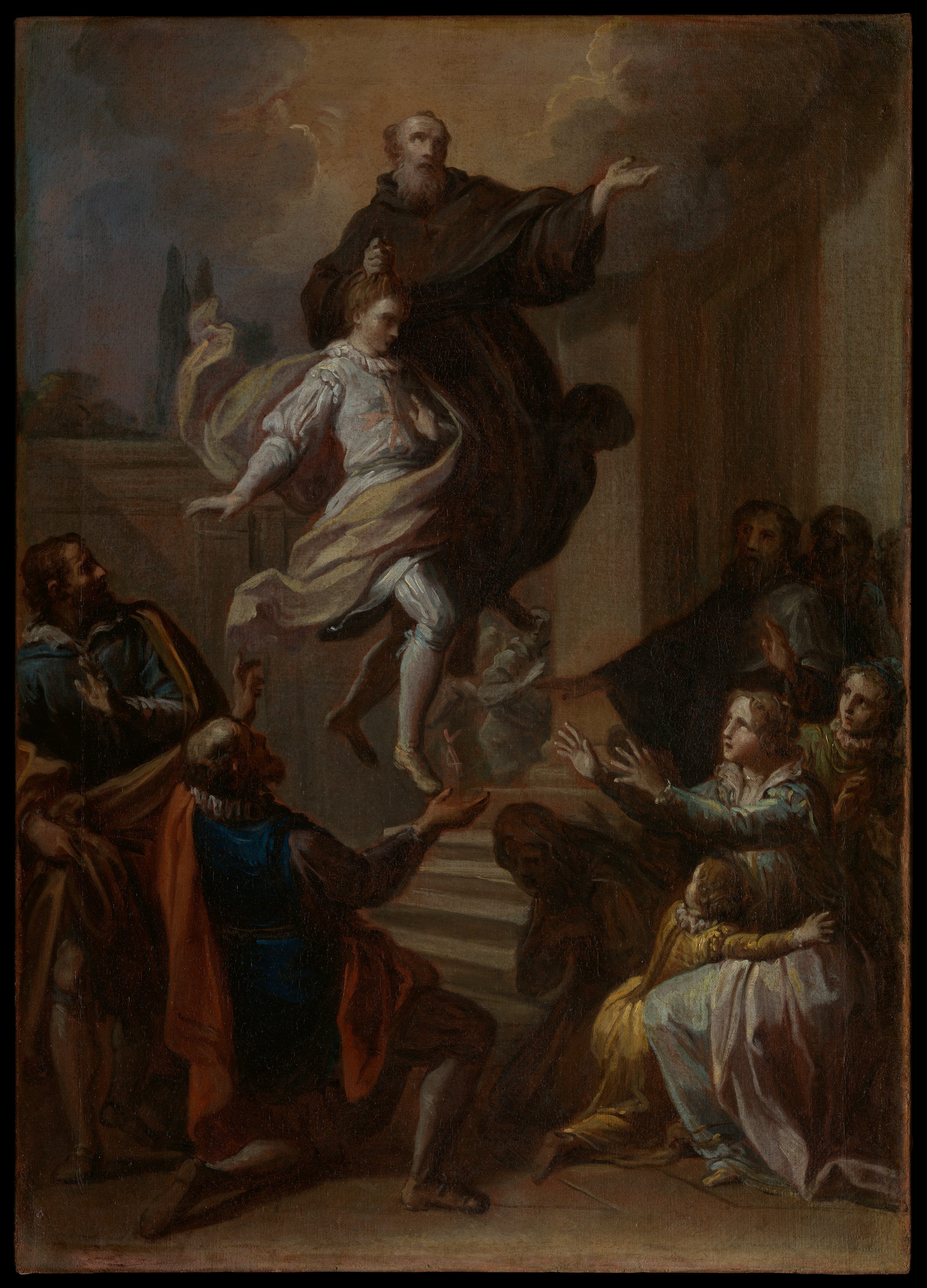
Introduction
St. Joseph of Cupertino1 is known for two things: being incredibly dim-witted, and flying. The 17th century mystic is a popular saint of the Catholic Church, especially among the test-taking aged of whom he is a patron. But is there adequate evidence to support his flight? This article presents three alternative accounts of his flight: (1) a naturalistic account, (2) a demonic account, and (3) a miraculous account. In the end, I conclude that based upon an extensive review of every scholarly source I could get my hands on, the miraculous account is the best explanation of the evidence from St. Joseph’s life, numerous witness accounts, and the failure of explanations (2) and (3).
A Note on Sources
I construct my biography from several sources, mainly:
Angelino Pastrovicchi’s Biography
Eric Dingwall’s Some Human Oddities
Michael Grosso’s The Man Who Could Fly: St. Joseph of Copertino and the Mystery of Levitation
I source most of my levitation claims from these modern sources:
Michael Grosso’s The Man Who Could Fly: St. Joseph of Copertino and the Mystery of Levitation
Douglas Scott Rogo’s Miracles: A Parascientific Inquiry Into Wondrous Phenomena
Rev. Robert D. Smith’s Comparative Miracles
Eric Dingwall’s Some Human Oddities
Carlos Eire’s They Flew: A History of the Impossible
Olivier Leroy’s Levitation: An Examination of the Evidence and Explanations
Herbert Thurston’s Physical Phenomena of Mysticism
The modern sources make use of the original documentary research from the following authors:
Angelo Pastrovicchi’s 1753 Compendio della vita, virtù e miracoli del beato Giuseppe da Copertino. An English translation is available here.
Domenico Bernino’s 1722 Vita del Venerabile Padre Fr. Giuseppe da Copertino de’ Minori Conventuali. Bernino claims to have personally witnessed an ecstacy from Cupertino.
Gustavo Parisciani’s 1963 San Giuseppe Da Copertino: Alla Luce dei Nuovi Documenti, for which I can only obtain an Companion Devotional Booklet.
Roberto Nuti’s 1678 Vita del Servo di Dio Fr. Giuseppe da Copertino, dell’Ordine de’Minori Conventuali. Nuti was Joseph’s confessor, and assembled a very early biographical account of his life.
The Bollandists’ Acta Sanctorum, accessible via the ProQuest database. In cases where I quote this directly, I am using Claude Opus 4.8 to translate the Latin.
A Brief Biography
Note - I list some accusations against Joseph within this biography without comment. I will raise the accusations again during my examinations of the possible accounts.
On June 17th, 1603, Joseph was born in a stable in Cupertino, Italy. His father had run into trouble with creditors on account of his generosity and had fled to find refuge in a Church. His mother, Francesca Panara, was incredibly strict with him in his early years, as St. Joseph was prone to spirited anger. Early in his life, he enjoyed visiting churches and constructed a small altar in his home where he would frequently pray. At age eight, he began experiencing religious ecstasies. During these ecstasies, he would frequently sit with his mouth agape, staring up into the sky.
During his upbringing, Joseph demonstrated remarkable spiritual fruit. He would regularly fast, abstain from meat, wear hair shirts, frequently attend and serve at Mass, and was exceptionally prayerful. His lifestyle took a toll on his body and he developed ulcers which spread across his body, confining him to bed. Some biographers report that he was miraculously healed by a hermit, though I obviously cannot directly confirm this account. What is agreed on and very plausible is that confinement to bed caused him to seriously lag in terms of motor development.
At 17, he attempted to join the Order of the Friars Minor Conventuals, but was rejected by uncles, members of the Order who thought he was too mentally inept to join the order. He then entered a Capuchin monastery as a lay brother, but was dismissed for being too absent minded and prone to fits of ecstasy which prevented him from performing his duties. Finally, Joseph was received as a third order member of the Order of Conventuals, where he was given the lowly task of taking care of a donkey. In spite of the number of rejections which he had received, he continued to practice remarkable devotion to God in prolonged fasting, sleeping on wooden boards, and wearing his hair shirt.
He was eventually received as a cleric and took the name Joseph Maria. In spite of being extremely unintelligent, the Bishop chose to waive his examination of him, due to being called away for urgent business. Joseph was ordained on March 28th, 1628. He stuck to his practicing rigorous physical discipline. He was frequently prone to outbursts of anger, especially at those who blasphemed or were practicing magic. Grosso reports that this anger led him to, on one occasion, attack a man for blaspheming God.
Once he was ordained, reports of his levitation emerged along with other miracles. A religious superior, Father Antonio, took him with him on visits to convents and monasteries in the area, where he (as recorded by Grosso) wrote:
Upon arriving at church with me, Joseph was immediately carried aloft in ecstasy. In sum, I visited and preached with words and he with deeds and life, which provided many of his brethren with occasions for self-reformation.
Joseph was reportedly very annoyed at being made a spectacle. However, Fr. Antonio reported that Joseph had great virtue, and brought him as an example of such virtue. These events, and growing popularity of Joseph, caught the eye of the inquisition, and he became the target of several church authorities who were distrustful of his character and miracles. In short, he was accused of false piety. What is noteworthy, however, is that the inquisitors did not suspect him of staging his levitation. They were concerned that he was under possession or that he was seeking to draw attention to himself.
Joseph was declared innocent of all charges by the inquisition in Naples, in spite of heavy opposition. However, he was later moved to Assisi to be in isolation and prevent further disturbances from his feats. Interestingly, his arrival was met by hostility from Fr. Antonio. Antonio was stationed there as the custodian (think Church warden) and began mistreating him. But Antonio himself was given a warning by the inquisition for harshly mistreating Joseph. According to Grosso, when asked to comment on Joseph by Rome, Antonio replied “I can say nothing except he was a saint who went into ecstasy continually and was adored by everybody.” This is in sharp contrast to the insults he laid on Joseph at Assisi, where he called him a “hypocrite and flighty as a puppet, mask of sanctity, liar and downright crazy.”
After nine years in Assisi, Pope Innocent X decided to reexamine the charges brought in Naples against Joseph due to his increasing fame. He was confined in a cell in Pietrarubbia, but began attracting even greater attention from people who came to see him. After three months, he was moved to a hermitage in Fossombrone. New miracles occurred there too, and more and more pilgrims flocked to see Joseph. In May of 1656, Alexander VII became pope. He sent Joseph to Osimo after declaring that “one Saint Francis of Assisi was enough” (Grosso). Grosso records that when Joseph was outside the walls of Osimo, he “emitted his characteristic prelevitational shriek, and flew from the porch to the top of an almond tree, a distance of fifteen yards.” Grosso calls this event “presumably well-witnessed.” Strict isolation was placed on Joseph there, and he lived out the last six years of his life in near complete solitude. Interestingly, Grosso records that during these last six years, the number of ecstasies and raptures he had increased in spite of illness. Father Maccatelli, a priest at Osimo, testified in Apostolic court that:
I can say that with my own eyes I have seen them take place in his room thousands of times.
Joseph died on September 18th, 1663.
Levitation Reports
Though many miracles were attributed to Joseph throughout his lifetime, I will focus on the levitations exclusively, since they are the most well attested and researched in the scholarly literature.
The astounding thing about St. Joseph is not simply that he was reported to levitate. This is recorded for a large number of Saints, per Olivier Leroy. What is unique about Joseph’s levitations is their quality and quantity. Carlos Eire, who has produced the most recent book on Joseph’s life and miracles, writes:
Saint Joseph not only levitates more frequently than any other saint in Christian history but also rises higher off the ground. He not only hovers but actually flies— not just indoors, where it is relatively easier to employ wires or other props and fool people, but also outdoors, where such trickery is relatively more difficult or impossible. And he flies forward and backward too.
What is even more astonishing is the vast number of witnesses to his levitations, and the nature of those witnesses. Eire recounts:
High clergy and nobility from all corners of Europe went out of their way to visit him and testified that they had beheld his levitations firsthand or begged for the privilege of visiting him, unsuccessfully. And some of these elites were among the most progressive boosters of the so-called Age of Reason, such as the Lutheran Duke John Frederick of Braunschweig-Lüneberg, patron of the very rational mathematician-philosopher Gottfried Wilhelm Leibniz, who served as his privy councillor and librarian, and the Lutheran Queen Christina of Sweden, who employed mathematician René Descartes as her court philosopher, possibly because he advised that “every thing must be doubted.”
Michael Grosso, another recent scholar of Cupertino, agrees:
Crucially, let me underscore: Joseph’s case doesn’t depend on a few good observations, one or two scenes that so-and-so mentioned, but on thirty-five years of roughly continuous eyewitness testimony. About 150 sworn eyewitness reports have been deposed, according to Parisciani—ordinary men and women, masons, surgeons, artists, popes, cardinals, ambassadors, theologians, inquisitors, dukes, kings, and princesses from all over Italy and parts of Europe.
Even one of Joseph’s skeptics, Rev. Robert D. Smith, admits in his book Comparative Miracles that:
St. Joseph of Cupertino (1603-1663), according to the published narratives of his life, provides by far the most outstanding instance of multiple levitations of which we have any records. It would be impossible to give a detailed account full of his elevations and flights, which seem to have been observed on more than a hundred different occasions … The facts of the levitations were geographically determined. Not only are they described as occurring in such varied places as Italy, Nardo, Assisi, Osimo, Fossombrone, Naples, and Rome, but in such and such a monastery: the Grotella, the Sacro Convento, and in such and such a chapel. Most of the reports give the date and even the hour of day. They cite many witness. The details are numerous and original, not the usual hagiographical clichés. The witnesses gave their testimony at an inquest begun two years after the death of the Saint; and this testimony was taken at the very places where the events occurred (Nardo, Assisi, Osimo). And a number of the witnesses held responsible positions in society, either intellectually or socially.
As a last point on this, Eire says that:
Tallying them seemed too large a task, apparently, as suggested by the fact that in the Assisi beatification inquest alone—one of several conducted in three different dioceses and over a dozen locations—there are 800 folios dedicated to his trances, ecstasies, raptures, and levitations.
The other aspect of these levitations which is of significant importance is their closeness to the reported events themselves. Unlike many hagiographical accounts which develop well over a hundred years after the reported miracles, the witnesses to Joseph’s miracles were the ones who testified to them. In the case of some of these miracles, the witnesses are testifying just a couple years after they allegedly saw Joseph levitate.
With this framework in mind, let’s turn to just a few of Joseph’s reported levitations.
Levitation Before Johann Friedrich
One exceptional account that is of Duke Johann Friedrich, a German Lutheran who specifically requested to meet Joseph at Assisi. Eire recounts that as Joseph was saying Mass, the following events occurred:
Taken to the chapel where Joseph was saying Mass through a side door—without Joseph being informed of his presence— the prince and his companions immediately experienced the Flying Friar’s super natural powers. Suddenly, as he was consecrating the Eucharist, Joseph found it impossible to break the host, as required at that moment of the Mass. Staring at the host, he gave a “tearful wail” and “with a very loud shriek, flew about five paces backwards in the air in a kneeling posture, and then back to the altar.” Then, after floating back down to the ground and remaining ecstatic for several minutes, he applied all his strength to the sacred host and finally broke it.
These events confused the Duke, and Joseph’s explanation was that since heretics with hard hearts had visited the chapel, the host became too hard to break. The following day, another miracle occurred:
Another miracle occurred at that Mass during consecration: A black cross suddenly appeared on the host, which all could see, and Joseph levitated again, remaining aloft above the altar for fifteen minutes with the host in his hands. As the duke wept openly, one of his companions who was also Lutheran moaned: “Cursed be the instant I set foot in this country; at home my mind was tranquil, but now here I’m rattled by the furies and scruples of conscience.”
Here, Joseph’s miracle is clearly given as a motive of credibility for Friedrich and his compatriots. The events caused Friedrich to renounce his Lutheran faith and become Catholic, which created a significant stir in Germany. Interestingly, Friedrich was a close acquaintance with the Lutheran philosopher and mathematician Gottfried Wilhelm Leibniz. Leibniz offers testimony of Friedrich’s conversion, writing:2
he thereupon came in February 1651 to Assisi, and there, before the so-called miracle-working Father Joseph, made his profession of the Roman Catholic faith, confessed at Loreto, and betook himself again to Venice.
Eire’s recounting of events is affirmed based on the original source work done by Bernino and Parisciani. This event is very commonly recounted among the sources I draw from.
Flight Before the Spanish Ambassador
In 1645, the Spanish Ambassador to the Papal Court and High Admiral of Castile, Juan Alfonso Henriquez de Cabrera, visited Joseph in his monastic cell. Herbert Thurston, in the 1952 Physical Phenomena of Mysticism recounts:
After conversing with him he returned to the church and told his wife “I have seen and spoken with another St. Francis.” As his wife then expressed a great desire to enjoy the same privilege, the Father Guardian gave Joseph an order to go down to the church and speak with Her Excellency. To this he made answer “I will obey, but I do not know whether I shall be able to speak with her.” In point of fact no sooner had he entered the church than his eyes rested on a statue of Mary Immaculate which stood over the altar, and he at once flew about a dozen paces over the heads of those present to the foot of the statue. Then after paying homage there for some short space and uttering his customary shrill cry he flew back again and straightway returned to his cell, leaving the Admiral, his wife and the large retinue which attended them speechless with astonishment.
As for the nature of the testimony of this event, Thurston writes:
Now this story is accompanied in the biographies both of Pastrovicchi and of Bernino with a great array of references to the depositions in the process, and it is expressly stated that these were made by witnesses “de vis” who had been actual spectators of the scene.
Olivier Leroy, in his 1928 book on levitation, gives a similar account of the events, based on the citations of Bernino:
This personage was Spanish Ambassador to the Papal Court, and passed through Assisi in 1645 with his wife, on purpose to visit the famous saint. He entertained him in his cell, and returned to the church, where his wife was waiting for him. “I have seen and spoken with another St. Francis,” he said to the latter, who also expressed her desire to meet Joseph. At her request the Father Custos ordered the saint to go into the church and speak with the lady. “I will comply,” answered Joseph, “but I do not know whether I shall be able to speak.” Scarcely had he entered the church, when he flew to a statue of the Immaculate Conception, twelve paces off, over the heads of the bystanders, alighted on the foot of the statue, prayed some moments there, and flew back, with his great cry, to his former place whence he returned instantly to his cell … according to the Acts of the process, she [the Ambassador’s wife] actually fainted, and required plenty of smelling-salts to recover her senses.
This story is well attested amongst the biographies I source from, and comes from firsthand accounts of those present.
Flight Before the Pope
British anthropologist Eric Dingwall records in his book Human Oddities that Joseph levitated when he was called before the Pope Urban VIII and the inquisition in Rome:
On finding himself in the presence of the Supreme Pontiff, Joseph was seized by ecstatic rapture and rose into the air, remaining suspended until recalled to his senses by the Father-General. The Pope was so much impressed by this surprising even that he is said to have declared that, should Joseph die during his pontificate, then he himself would testify to the truth of what he had seen.
Dingwall and Leroy both describe this account and cite Bernino as their source. Bernino almost certainly got it from the beatification processes of Assisi, as this is where the Acta Sanctorum’s 1755 documentation of Joseph’s life says their information is from. In the case of the Acta, they can cite the folio which the story is included in, as well as the name of the Father-General who witnessed the event. We would expect this testimony to emerge from Assisi, as this is where Joseph was living at the time he was called to Rome.
Levitation and Healing of Balthasar Rossi
One particularly unique levitation is the assisted levitation of Balthasar Rossi at the monastery in Assisi. Rossi was a noble who was suffering from some sort of mental issue. Leroy states:
He was led to the saint bound to a chair, for he was dangerous and used to assault people, saying they were mad. Joseph ordered the man to be set free, made him kneel down in his oratory, and, laying his hand on his head, said: “Do not fear, Chevalier Baltasar; commend yourself to God and his Holy Mother.” With these words, he clutched the lunatic by the hair, uttered his usual cry, and was raised off the floor with Baltasar, whom he held for a time in mid-air to the amazement of the bystanders. Then, after a quarter of an hour, he sank to earth again and dismissed the nobleman with these words, “Now, cheer up, Chevalier!”
Leroy sources the story from Bernino, and the Acta adds that that Rossi was healed as a result of the flight. Eire also recounts the story and notes that Pastrovicchi also attests to it. Once again, this testimony comes out of the processes at Assisi, which means the story likely emerged from there.
Flight Outside of Osimo
When Joseph was being moved to Osimo, a miracle occurred as he was outside the city. Dingwall records the following from Bernino and the Acta:
Having almost arrived at Osimo, Joseph tarried a short time to gaze at the cupola of Loreto, a sight which brought on the state of rapture. Uttering his usual cry, Joseph declared that he saw the angels ascending and descending, and promptly rose into the air, and with his eyes fixed on the Holy House flew a distance of some twenty-five to thirty yards and at a height of about 12 palms to the foot of an almond tree.
The “Holy House” is a reference to the Holy House of Loreto, a different miracle in the Catholic tradition which we will leave aside for the purposes of this article. Grosso gives a similar testimony, drawing his story from Pastrovicchi:
The legend surrounding the itinerary of the Holy House has it being moved by unknown means from Palestine to the Italian coastal town of Loreto. Joseph promptly claimed to see angels in flight over the city of Loreto, emitted his characteristic prelevitational shriek, and flew from the porch to the top of an almond tree, a distance of fifteen yards.
Leroy, drawing from the Acta Sanctorum:
On July 10, 1657, as he was going to the monastery of Osimo where he was transferred by order of the Pope, Joseph was shown by a priest the cupola of the church of Loreto, which is about six miles from Osimo. On looking, the saint had a rapture, and exclaimed: ‘‘ Do you not see the angels ascending and descending from heaven to that Sanctuary?” And uttering his cry, he flew through the air about twelve palms high to an almond-tree about thirty yards away.
The Acta cite this story as being preserved in the Apostolic Process of Osimo, another instance of a story emerging from a place where Joseph lived.
Levitation in His Last Hours
Francesco Pierpaolo was Joseph’s surgeon on Joseph’s deathbed at Osimo. According to Grosso drawing on Bernino, he deposed that he saw Joseph levitate four times:
During his last illness, in the act of cauterizing the right leg by order of Doctor Giacinto Carosi, while he sat in his chair with his right leg propped up on my knee, I began to operate on him with instruments. I realized he could not feel a thing that I was doing during the operation. He sat there with his arms spread, his eyes open, his face turned toward heaven; the mouth was slightly open without giving a sign that he was breathing and I noticed that Padre Giuseppe was rising up into the air about a palm’s length from the chair. He remained in the position he’d been in before, completely out of his senses. Moreover, I noticed that a fly was on the pupil of his eye and it kept returning even when I’d shoo it away. I got on my knees to better observe Padre Giuseppe, as did the doctor, who was also present, and we both verified that not only was he entirely out of his senses but he had also floated above the ground into the air in the way I’ve said. Seven or eight minutes passed with him in this state. Silvestro and the brothers of the convent who saw this said to “Call him by name!” And in holy obedience he returned to himself, with a smile on his face, and sat again in the chair as he had been sitting before, telling me to continue with the cauterization. I told him that it was done and he, not believing me, insisted I was teasing him. I let him see the leg already tied. He remarked that he hadn’t felt any pain at all.
This account is particularly incredible for several reasons. First, it is very likely firsthand testimony taken from the depositions at Osimo, as confirmed by the Acta. Second, the surgeon can be taken as a reliable witness, not only because he would be a man of science trained in medicine (less likely to be duped by simple tricks), but because, third, he recounts an embarrassing story that is recorded in the Acta:
Postremum hoc chirurgo suo præsertim præstitit, qui, licet Servum Dei inter sectiones & cauteria, curandi ergo sæpe adhibita, suaviter raptum, omnisque sensus expertem sæpe miratus sit, multo tamen magis stupuit, cum ab eodem audiit sibi revelari quemdam defectum suum maxime occultum, & a longo tempore commissum, quique illi ipsi jam exciderat ex memoria.
He showed this last [gift] especially to his surgeon, who — although he had often marveled to see the Servant of God gently caught up in rapture and devoid of all sensation amid the incisions and cauterizations frequently applied for treatment — was nevertheless astonished much more when he heard revealed to him by that same man a certain fault of his own, most hidden and committed long ago, which had by then slipped from his very memory.
This same detail of sin being revealed to the surgeon is affirmed by Eire, drawing on Pastrovicchi. Fourth and finally, this testimony is very close chronologically to the events described, likely one of the closest accounts we have.
The Naturalistic Account
Given these stories which I have just laid out, what would a skeptic, someone who doubts the existence of miracles, or who has some other reason to deny the miracles of Joseph, have to say about the matter?
There are two primary skeptical accounts which are given, one from the aforementioned Rev. Robert D. Smith in 1965, and one from Joe Nickell, a writer for Skeptical Inquirer.
Smith has roughly five objections. I will state the objection and then give an answer before proceeding to the next objection.
The main two biographies which we source from, Bernino and Pastrovicchi, drew from records of the inquest. But the record of the canonization processes are extremely rare, and no one who has recently studied the question thoroughly has used the original documents in their investigation.
Response: Smith is actually incorrect in stating this, though he can’t be faulted. Gustavo Parisciani actually took up this very task and published his work in 1963, drawing on new witnesses which were unknown to the literature at the time of Smith’s writing. And yet, he does not significantly undermine any stories which we have access to. In fact, he is cited frequently in Eire’s book, which very positively affirms Joseph's levitations. The reason Smith is unaware of this work is that it was published by a small Italian publishing house, and never received an English translation.
The later biographies indicate that there are issues in the original depositions and their transmission, evidenced by discrepancies between the witnesses.
The example Smith gives of contradictory testimony is another recorded levitation that I did not mention. In the story, Joseph assists farmers in carrying large wooden crosses and placing them in pre-dug holes by carrying them while flying. The issue with the story is that Pastrovicchi says Joseph flew fifteen paces, while Bernino says he rose eighty paces. I agree this casts doubt on the witness testimony for this specific case, but would make two specific counterpoints:
This testimony at the very least shows a story of Joseph levitating at a certain height. Perhaps the eighty paces is a wild exaggeration that developed later, but there is some preserved story in particular that both stories seem to be drawing from.
The difference of fifteen paces and eighty paces is a lot, but this is not the difference recorded by most stories. In most stories, the difference is of a few feet, exactly what we would expect of a set of independent witnesses trying to remember a prior event. They all remember that Joseph flew, but can’t pin down exactly how many feet.
There is a large time lag for some of the earliest accounts.
This is true, and likely the biggest reason to doubt some of the testimony. However, it cannot account for the widespread nature of these accounts, both in span of time and geography. If this was simply a legend that developed after Joseph’s death among the townsfolk, why did it spread so far, and specifically to other towns Joseph visited? How did it arise in the first place? Even if the accounts are questionably reliable in the details, they still preserve levitation as a feature of Joseph’s life, a strange fact if he never levitated at all. Finally, while we may forget small details and days of our lives over time, we tend not to forget large, incredible events. An obvious example of a large incredible event we would not forget is levitation.
There are reasons to believe Joseph may have been a gymnast based on descriptions of bounding or leaping by Joseph. This could indicate that some witnesses mistook Joseph’s agility for levitation.
See my reply to Nickell shortly, as much of his skeptical account relies on this argument. Needless to say, I think it is a very weak argument.
Benedict XIV does not seem to explicitly affirm the levitations even though he affirmed the canonizations.
This is plainly false. Benedict says:
Whilst I discharged the office of Promotor of the Faith the cause of the Venerable Servant of God, Joseph of Copertino came up for discussion in the Congregation of Sacred Rites, which after my retirement was brought to a favourable conclusion, and in this eye-witnesses of unchallengeable integrity gave evidence of the famous upliftings from the ground and prolonged flights of the aforesaid Servant of God when rapt in ecstasy.
So we see that Smith’s skepticism regarding the timing and credibility of the witnesses is plainly false. But what about St. Joseph’s supposed athletic prowess?
In Skeptical Enquirer Volume 42, No. 4, Joe Nickell lays out a number of explanations for some of Joseph’s miracles. In short, Nickell believes that Joseph was something of an acrobat in a traveling spiritual circus, being moved about Italy by his prelate to dupe poor, dumb peasants into embracing Catholicism. As Nickell writes:
Now let us examine some of the more extreme defiances of gravity that Joseph supposedly accomplished. That he could stand on tiptoe and even seem to slightly rise and hover may only indicate wonderful strength, balance, and acting; I suspect such acts were fundamentally stunts that may have led credulous seventeenth-century peasants to believe it was accomplished by levitation.
To respond to Nickell, I will first address his framing of the issue, and then turn to point out the laughable absurdities he proposes as explanations for some of Joseph’s flights.
Nickell’s article ascribes two particular traits to Joseph: duplicity and athleticism. Neither is borne out by the accounts we have of Joseph’s life.
Duplicity?
Nickell frequently portrays Joseph as a conman. Though he never establishes this fact from any records of Joseph that we have, he gestures to it by naming two examples of people close to Joseph who seem to have been hostile towards him:
In time, the prelate who had taken the friar on tour would tell Roman authorities, “I can say nothing except that he was a saint who went into ecstasy and was adored by everybody” (Chiappinelli 2008)—hardly a ringing endorsement of one who purportedly flew like a bird. Another, a traveling companion to Joseph for years, suddenly requested to be sent away from him (Grosso 2016, 29)—a mystery that seems to bespeak some dark secret, possibly knowledge of deception.
The prelate, Father Antonio, is a complicated man. I address some of these complications in my brief biography. We know that at least one point, he was collaborating with Joseph. Once Joseph reaches Assisi, the abuse begins. What is curious is that the quote given is what Antonio said to Rome, but notice what the quote says. It calls Joseph a saint and adored by all. The particular context of the quote is Joseph’s trials in Rome, where his character was of primary question. If Father Antonio truly doubted the veracity of Joseph’s miracles, why did he not inform Rome that he believed Joseph was lying about his miraculous feats? If anything, this quote strengthens the character of Joseph because it shows that he was morally impenetrable, even to those who were hostile to him.
The second traveling companion simply cannot be used to weigh in either direction of this case. We do not have the original records of the traveling companion leaving. We don’t have his motive. We don’t even know his name. So to use this, when there could be any number of reasons for asking to be dismissed, is just post hoc attacks on Joseph’s character.
To the overall idea that Joseph could be a con man, this idea seems essentially impossible. Joseph, throughout his life, showed little interest in fame. He was obedient to his superiors, moving wherever the Church sent him. He engaged in acts of penance and self-flagellation so great that his superior had to step in and stop him. He slept on wooden boards, fasted frequently, constantly kneeled in prayer, and was by all accounts an incredibly pious priest. He lived a life of humble and obedient virtue, in spite of constant opposition from Church authorities. He was declared innocent by the inquisition after lengthy trials. With all this incredible virtue, and clear belief in the teachings of Jesus and the Catholic Church, why would Joseph engage in consistent lying and deception, something which is always considered a sin by the Catholic Church?
Most tellingly, Joseph’s “devil’s advocate,” Prosper Lambertini, the man tasked with giving every possible reason Joseph should not be beatified, became Pope Benedict XIV, and beatified him. This should be weighted very heavily in favor of Joseph, because Lambertini would have had access to the witnesses accounts directly. He would know about inconsistencies in the testimony. Not only that, but Lambertini was well known for being critically-minded, in particular because he published a lengthy treatise on scientifically examining canonization cases as Benedict XIV. If the man tasked with finding fault in Joseph is the same man who beatified him on account of his virtue and miracles, then it is safe to say Joseph possessed extreme virtue and certainly could not be a con man.
Athletic Prowess?
This objection is leveled by Smith and Nickell, and seems to arise from the fact that in some cases, Joseph is described as leaping and bounding far distances, or hanging on to something as he levitates. But this simply cannot stand up to scrutiny. Joseph was a sickly child, mainly on account of his fasting. As an adult, he fasted often. He had, by Nickell’s own admission, sores on his knees from kneeling so long and so frequently. The idea that Joseph could somehow obtain the athleticism required to dupe hundreds of people, including well educated popes and princes, some of whom were hostile to him, is an utter absurdity. We have no record of Joseph training as an athlete, making any sort of indication of athleticism, or anyone around him claiming he was an athlete explicitly. And, as I will show momentarily, even if Joseph did possess these athletic traits, it simply cannot account for some of his feats.
Fanciful Witnesses?
Part of Nickell’s account must also rely on the suggestibility of the witnesses who saw Joseph levitate. Leaving aside Nickell’s biased view against the intelligence of medieval peasants, it is simply inconceivable that Joseph could have duped the number of people in high office as he did. A Lutheran Duke would be able to distinguish a large leap from flight. Again, note the quality and quantity of the witnesses. The genius that would be required of Joseph to dupe all of these people, when we know from all records of him that he was likely very unintelligent, is simply improbable.
Nickell’s framing, then, fails to establish Joseph as a fraud or athlete, and is too dismissive of the witnesses involved. But what about the specific refutations given by Nickell of Joseph’s feats?
Lutheran Duke
For instance, during a Duke’s visit Joseph began to wail, then gave a great scream and flew into the air backward in a kneeling position (original emphasis, Bernini 1722, 85). But did he simply spring backward? Details are too unclear: Did kneeling become crouching and afterward a crouch return to kneeling—the truth concealed by the friar’s tunic?
As I showed in the previous section, Joseph’s leap was recorded at five paces, about 12.5 feet. Even leaving aside what position Joseph was in at any point during this event, it is improbable that Joseph set the standing backward jump record, smashing current world record holder Lorenz Wetscher’s eight foot, six inch record. Nickell’s explanation is simply implausible, even if Joseph was crouching to begin the jump.
Of the second levitation before Johann, we can see how Nickell seeks to account for yet another levitation that I didn’t mention:
Once, some talented young singers were brought to Joseph’s room to perform for him. Their singing sent him into such ecstasy that he fell on his knees, then rose and floated just above the ground. In confirmation, the three boys “put their hands between Joseph’s tunic and the ground” (Parisciani 1963, 443) … Because of Joseph’s station, the boys would have been compliant, not aggressively skeptical. Note that the friar’s feet are never mentioned, indicating that he rose while still apparently kneeling. But recall my earlier suggestion, regarding the “backward levitations,” that Joseph could subtly move from kneeling to a pre-crouch position by placing the bottoms of his toes flat on the floor. As he then moves slowly into a crouch using his well-developed muscles (you see where this is going), the still-apparently kneeling friar is witnessed rising upward—or rather his knees are seen to rise, giving that illusion. The rest is child’s play, literally. The boys are invited to place their hands between the tunic and the floor. It would probably not occur to them to reach far back and search for the actual placement of Father Joseph’s feet.
First, note that these “well-developed muscles” are never substantiated by Nickell in any way, they are simply assumed. Second, the mechanism described is only plausible if Joseph was doing this for a little under a minute. After a minute, he would begin shaking, which would contradict the consistent witness testimony that Joseph was static during these elevations. In the case of the Duke, Joseph was elevated for fifteen minutes, an impossible amount of time to keep a static squat held. Note also the hilarious explanation that the singers never thought to move their hands as far back as Joseph’s feet. This imputes a kind of comical suggestibility on them which makes the skeptical account less plausible.
Joseph’s Greater Flights
When attempting to explain the flight witnessed by the Spanish ambassadors, Nickell points to the particular language employed by Bernini:
Let us start with an incident in which Joseph “flew” to the feet of a statue that stood more than a man’s height above the ground; there he adored it while “floating midair” (Grosso 2016, 81–82). In fact, all the time he “embraced” (i.e., held onto the feet of) the statue! Perhaps with muscular ability he extended his body horizontally to add to the effect.
This explanation is more of the same obfuscation. It totally ignores the part of the story where Joseph flies over the heads of the ambassadors and then proceeds to fly back over the heads of the ambassadors. Sure, Joseph could have done a human flag for a few seconds. But how did he achieve such flight? Theatre wire had not yet been invented. A jump of such incredible distance into a human flag is only less impossible than proceeding to jump from a human flag back over the ambassadors.
Note also that when Nickell seeks to employ this testimony to refute another levitation I didn’t mention, he must stretch his human flag explanation to impossibility:
Another example is also instructive. The account (Bernini 1722, 26) quotes a deposition by some shepherds (who were probably illiterate), apparently given years later. Father Joseph was dancing excitedly in the name of the church, when he:
… suddenly sighed and loudly screamed and flew up in the air like a bird, halfway to the ceiling, where he continued dancing above the main altar, and went to embrace the tabernacle that was a considerable distance above the main altar. This was all the more marvelous because the altar was filled with flaming candles and he rested between the candles without knocking over even one. He stayed that way with his knees above the altar, embracing the tabernacle with both arms, for about fifteen minutes …
It is apparent from his movements that he bounded, in increments, onto the altar where he “rested between the candles”—that is, on the support that held them. And there, for the several minutes duration, he was “embracing”—in other words, holding onto—the tabernacle (which contained the Eucharist). He was never simply floating in air, as sources may seem to imply.
Of course, we all know illiteracy causes people to mistake simple jumps for flight halfway to the ceiling. But joking aside, notice what Nickell posits. Joseph held onto the tabernacle (a gold box affixed to the high altar which holds the Eucharist), for fifteen minutes. This means Joseph was holding a human flag (see the photo below) for fifteen times longer than the current world record holder Wang Zhonghua, who set a record of one minute, five seconds.

Notice also that Joseph would have been facing towards the altar with his arms in front of him, a much more challenging task than the standard human flag.
So Nickell’s accounts of these events fail on the grounds of physical impossibility. I will now consider a few more skeptical objections.
Wires?
Was Joseph potentially making use of theater wire? No. Theatre wire was not invented until the 1800s. In order to support himself, Joseph would have had to make use of rope, and anything which possessed the ability to hold him would likely have to be very bulky and obviously visible. It would also require some pulley system or hook to achieve the effect, something which would become obvious if Joseph’s path took a pendulum like arc, something that is clearly contrary to the testimony given by the sources. This also cannot account for miracles like the ones at Osimo which took place outside.
Trampolines?
The first trampolines which could be small enough to be concealed and powerful enough to launch Joseph several feet into the air were not invented until the 1900s at the earliest. Furthermore, this cannot account for outdoor flight, or really even flight in a church, as the trampoline would be obviously visible.
Just a Really Good Tree Climber?
Nickell reflects that some of the levitations involve Joseph landing in a tree. He then argues that Joseph simply climbed the tree so fast that he convinced a fellow priest that he had flown:
Note the use of the word bounding plus the fact that olive trees are typically of low height (described as “short” and “squat” [“Olive” 2017]). Remember too that Joseph was practiced in kneeling for long hours. Besides, bounding upward was one thing, but after coming out of his supposed rapture he had to have help getting down! So the other priest fetched a ladder for the catlike friar.
But this is ridiculous. No one mistakes tree climbing for flight. An olive tree when fully matured is typically 20 to 30 feet. Scaling a 20 foot tree so fast that the priest watching you do it thinks you flew is a miracle in its own right. If the olive tree was immature, then the miracle becomes the fact that Joseph stayed on the tree branch kneeling for thirty minutes, which would be difficult to handle for a baby olive tree. It also fails to account for all of the non-tree related miracles, as well as the miracle at Osimo where Joseph only climbed the tree after flying 25 yards.
One commenter has also argued that Nickell is suggesting that Joseph simply leapt up on to the tree rather than climbed. This interpretation is equally implausible. Joseph would have either needed to jump into a kneeling position on to a branch high above the ground or jumped, grabbed a branch, and pulled himself up onto it. The latter is an absurd suggestion for all the reasons I’ve presented earlier. The former is unlikely to have been mistaken for flight.
Why did Joseph require help getting down? It seems Joseph’s flight was imposed on him, so if his flight brought him to a place where he needed assistance this would be unproblematic on the miraculous account. How this weights the probability of the flights being naturally explicable is difficult to discern, and I will leave it to the reader to weigh it themselves.
Just Mere Legend?
Of course, a pressing objection given by both Smith and Nickell is the insinuation that this levitation may simply be a local legend. Sure, perhaps Cupertino was not tricking people. But maybe this legend developed apart from his own will. There are hundreds of accounts of saintly miracles which seem grossly implausible that did not emerge with the saint. Why can’t this be one of them? We know that Joseph was prone to fits of ecstasy in which he would look up, mouth agape, at the sky. This is possibly the best attested fact of his life. For the skeptic, this is the pinpoint on which the levitation legend could have emerged. At some point, credulous Italian peasants begin misremembering Joseph as hovering off the ground in his states of ecstasy. Then, over time, the magnitude of the levitations begin increasing, and people became primed to see Joseph’s ordinary ecstasies as levitation.
I believe there are several crucial problems with this argument. The primary issue is how the legend emerged in the first place within Joseph’s own lifetime. Joseph, as I have pointed out, was moved several times throughout his life. We may expect that in Joseph’s childhood town, such legends could emerge after he had left and fester there, only reemerging after his own death. But instead, the legends seem to follow Joseph, bubbling up wherever he goes. Furthermore, the legends don’t simply percolate among the peasant class, but among everyone who is interacting with Joseph, including his own interrogators. If Joseph was simply going into bouts of ecstasy, why did he not make such clarifications to the inquisition? Joseph could have simply made a public statement that he never levitated. And yet, even up until his final weeks of life, we have those who are closest to Joseph, his surgeons and fellow priests, coming to believe he levitated. The other main issue is how close the witnesses are to the reported events. Joseph’s beatification trials began just a year or so after his death. This means that the original, firsthand witnesses to Joseph’s levitations are still alive at the time of his beatification trials. Finally, consider the specific cases. If these stories were simply legends that followed Joseph, why were they converting skeptical Protestants in Catholics? This fact makes legendary development much less likely given the hostility of at least some of the witnesses.
Given the closeness of the accounts to the dates they report and the unity of the eyewitness in affirming that Joseph levitated, there is not reason to believe that these levitation accounts developed as legend.
In Sum
Eire gives four strong reasons to doubt the naturalistic account:
The levitations are so extreme as to make the likelihood of trickery seem remote, unlikely, or technologically impossible.
The number and status of his witnesses make the accounts seem more credible, even as his levitations become more extreme.
Those who witness Joseph’s flights are not just other clergy or religious, but members of the highest echelons of society.
The witnesses of the levitations are incredibly varied in quality. These miracles were highly public leading up to Fossombrone.
These reasons, taken in conjunction with the failure of the skeptical explanations provided by Nickell, should lead every rational person to reject the naturalistic account. We simply have too much evidence to the fact that Joseph levitated in the presence of a great number of witnesses, many of whom were reliable intellectuals that would not be easily fooled by whatever trick could be proposed for Joseph’s levitation.
The Demonic Account
Might Joseph have been possessed by some spirit other than a divine one? There are stories, especially in some of the texts I previously mentioned, of levitation occurring outside of a Christian context. Indeed, exorcist records often claim that demons have the ability to move their victims through the air, yank them around, and levitate them. Might Joseph have been subjected to such demonic forces?
I argue this is implausible on account of Joseph’s supernatural virtue. Once we have accepted that divine explanations are possible, we must begin factoring in the fact that Joseph displayed incredible amounts of devotion to God, Jesus Christ, the Virgin Mary, and the Church. This is exactly the opposite kind of practice we would expect from a demon possessed person. We certainly would not expect that person to engage in rigorous fasting, penance, and self-flagellation in the name of Jesus Christ. Joseph’s devotion to Jesus on its own is enough to overturn the demonic account.
The fact that such miracles seem to have been imposed on Joseph, rather than as a result of his own power, can only be evidence towards a divine explanation, not a demonic or miraculous one itself. What the demonic account must show to succeed is why demons would want to levitate Joseph. What vested interest did they have in strengthening the credibility of the Catholic faith?
Furthermore, if the demonic account succeeds, it would seem to undermine credibility of the Christian account of demons. How can a holy man become demon possessed for thirty-five years and continue to practice prayer, fasting, and penance?
The Miraculous Account
Having ruled out the other explanations, I now turn to the miracle account of events. On this account, Joseph was a very holy man from his childhood. He showed immense devotion to God in spite of adversity which kept him from the religious life and priesthood. God has several reasons we can postulate for levitating Joseph:
Demonstrating Joseph’s personal holiness.
Demonstrating God’s own divine power over nature.
Demonstrate that education is not a requirement for holiness.
Converting Protestants (as we know happened).
Strengthening the faith of Catholic believers at the time of the reformation.
3 and 4 seem especially important. The use of miracles as a motive of credibility is well established by the Old and New Testament. Jesus frequently relies on his miracles to establish the truth of his teaching to the Pharisees. The apostles use miracles to establish their divine authority, and Paul cites his own miracles as evidence for his apostleship. If God wanted to confirm the true faith at the time of competition between two claimants to “the true Church,” it seems obvious that he would want to put the miracles which indicate extreme holiness on the side of the Church he established. To this point, Joseph’s persona seems incredibly emblematic of the Catholic understanding of how we are to understand and establish the true Church. Joseph is obedient to his superiors in spite of persecution. He never once disobeys direct requests, even when they harm him personally. He converts Protestants not with lofty arguments from scriptures, but from signs and wonders which are clearly of a divine origin. His miracles, aside from affirming the value of the Eucharist (as seen in the Johann example), also strengthen the faith of the peasants around him. This is the Catholic paradigm of the motives of credibility, to which Joseph is a strong witness.
The failure of the naturalistic and demonic accounts leaves us with a single miraculous account. Mere legend is improbable given the scope and scale of reports about Joseph’s levitations, especially in light of the fact that the events were reported by firsthand witnesses.
Conclusion
Based on a careful reconstruction of his biography and a thorough examination of competing claims, this article establishes that St. Joseph of Cupertino levitated and flew through the power of God. These miracles are so well attested that they provide powerful testimony to the existence of God and the power of the true Church.
Correction: The original article stated that Prosper Lambertini would have been able to interview the eyewitnesses. This was erroneous and has since been corrected.
I use the English spelling of Cupertino rather the Italian spelling of Copertino throughout, though some books referenced will prefer an alternative spelling.
nicely written!
Agree that the evidence for St. Joseph of Cupertino's levitation is overwhelming, but why opt for a miraculous explanation as opposed to say a parapsychological one?