
“And now we ask that you will pray for our son. Please pray through the intercession of Saint James, Saint Linus, and Archbishop Sheen. If James comes through with no problems, we will definitely attribute it to a miracle for our local saint.”
-Bonnie Engstrom, 61 Minutes to a Miracle: Fulton Sheen and a True Story of the Impossible
Introduction
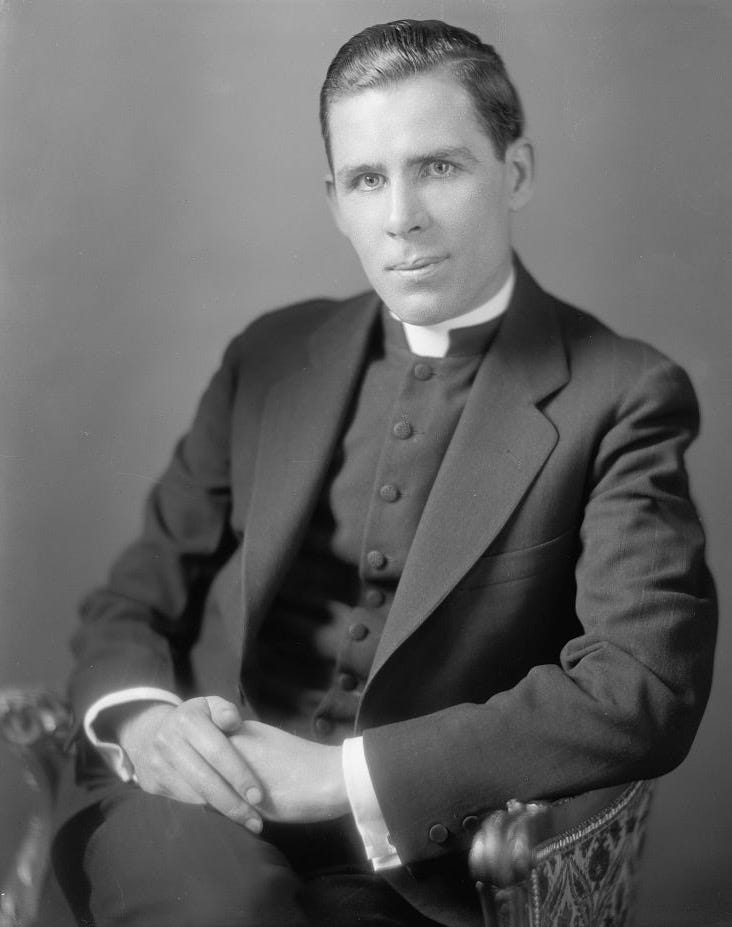
Venerable Fulton Sheen lived from 1895-1979 and was one of the most beloved Catholic prelates of the 20th century. Ordained in 1919, Sheen went on to serve as the auxiliary bishop of New York, national director of the Society for the Propagation of the Faith, bishop of Rochester, titular archbishop of Newport, Wales, and finally as assistant to the Pontifical Throne during the Papacy of Pope Saint Paul VI. Between 1951 and 1957, he hosted the television series “Life is Worth Living” which amassed approximately 30 million viewers. In the sixties, Sheen hosted another popular show, “The Bishop Fulton Sheen Show.”
Sheen was declared “Venerable” by Pope Benedict XVI in 2012 as the Church officially recognized him to have lived a life of holy virtue. In 2019, Pope Francis approved a miracle attributed to Venerable Fulton Sheen’s intercession which made possible his beatification. On September 24, 2026, Venerable Fulton Sheen will be declared by the Catholic Church to be a Blessed, opening the way for his local veneration.
In this article, I will do a deep dive into the alleged miracle that has justified Sheen’s beatification. This miracle occurred in 2010 with the healing of a stillborn boy who went an hour without a heartbeat. I will begin by sharing the narrative of the healing, largely taken from the book written by Bonnie Engstrom, the boy’s mother.1 Then, I will provide a medical analysis of the alleged miracle according to our most up-to-date scientific literature and detail the process of scrutiny this miracle faced. Finally, I will show how Fulton Sheen’s intercession played a role in this miracle.
The Miracle
On September 16, 2010, James Fulton Engstrom was born in his parents’ home without a pulse. A knot in James’ umbilical cord had cut off his supply of oxygen during delivery. After 19 minutes of CPR and attempts to give James supplemental oxygen, paramedics arrived and intubated James. On the ambulance, the heart monitor attached to James only displayed pulseless electrical activity. As his mother Bonnie Engstrom reflected, “Legally, he could have been declared dead.”2 The paramedics gave James two doses of epinephrine, which failed to restart his heart. They arrived at the hospital 44 minutes after James’ birth; his skin had turned from blue to a gray white, and he still had no pulse. At the hospital, the medical team continued chest compressions and administered additional epinephrine. In order to see what James’ heart was doing, they brought in a sonogram machine. 51 minutes after James’ birth, doctors observed a flutter of his heart, an ineffective heartbeat. At 56 minutes, the doctors prepared to give up but resolved to try for a little bit longer. Engstrom recounts:3
Later, we learned that at this point the goal was not to save his life; everyone knew that even if his heart began to beat again, he would not live for long. The goal was for James to have a pulse long enough for his parents to hold a warm, living baby, tell him they loved him, and say goodbye.
At 61 minutes without a pulse, the doctors and nurses stopped, taking their hands off James, ready to declare his time of death. But:4
At that moment, astonishingly, James’ heart began to beat.
However, the outlook was still very dire. The emergency staff appeared sorrowful; they knew that James’ “life would be most likely short and horrible,” and felt that “it would have been better if he had never revived.”5 He was quickly transferred to the NICU, where all signs indicated he would shortly die. James’ blood pH sat at a very acidic 6.7, indicative of impending death.6 As Engstrom recalls:7
A feeding tube, a breathing tube, and an internal thermometer were all down his throat. There were IVs into the large veins near his groin and his umbilical cord vessels. There were wires on his chest, foot, and finger to monitor his oxygen levels, heart rate, and other vital signs. He was heavily sedated, and the ventilator breathed for him. He didn’t move except for an occasional shiver.
The situation was grim, and the medical team doubted James would survive the week, or even the day. As the doctors studied his medical records, James’ primary doctor became perplexed:8
‘That’s not right,’ she said. ‘That can’t be right.’
The doctors realized that James had gone 61 minutes without a heartbeat and came back to life. He had been dead for over an hour. The doctor immediately ordered EEGs9 and MRIs10 to assess James’ brain. The first EEG test occurred while James was still sedated, and gave no significant results besides the fact of his sedation. At three days old, James received a second EEG and an MRI, receiving a staggering diagnosis:11
The report from the second test was devastating: James’s brain was highly abnormal. His MRI, a scan of brain tissue, also showed injury to the brain, attributed to severe hypoxic ischemia — his brain had been severely deprived of oxygen.
The prognosis was that if James did not die within a few days, he would remain in a vegetative state for a short time before dying. Medical staff believed that James’ organs would begin shutting down “one by one, until he was dead.”12 If he happened to improve, he would be severely disabled. James’ developmental pediatrician explained to his family that he would be seriously impacted by cerebral palsy:13
The developmental pediatrician, a specialist with Easterseals, warned that James would probably be unable to control his body and would need to be strapped into a wheelchair once he was older. Mentally, he would never develop beyond the level of an infant or toddler. He would most likely be blind and unable to talk, suffer from seizures, and be in diapers for the rest of his life.
James’ feeding and speech therapist came shortly after with further bad news:14
James wasn’t taking his bottle well, she said, and a test showed he was silently aspirating food into his lungs. His lungs could easily be filling with liquid, but because he didn’t cough — which would help clear them — we would never know. She further explained that his gag reflex was inconsistent and that he needed his feedings through a feeding tube.
I asked her whether she thought James would ever overcome these things to eat and drink normally … ‘Probably not,’ she told me.
In the following days, James’ colon, liver, kidneys, heart, and lungs were all confirmed to be in working condition. This gave the doctors hope that the brain damage may not be as bad as they expected. After six days old, James’ eyesight began to function. At nine days old, he could breathe on his own.15 With continued improvements, James was discharged from the NICU and went home after seven weeks. However, he had to keep a feeding tube due to struggles with eating.16
At three months old, James received a follow-up MRI to analyze his brain. It is important to pause and note that the doctors ordered this MRI to:17
Let us know the lasting effects of the hour he was dead when his brain didn’t get oxygen.
The doctors anticipated damage in the brain. However, once the results came back, Bonnie Engstrom recounts receiving shocking news:18
On the line was a nurse from our family doctor’s office; she had the results from the MRI. There was no inflammation and no extra fluid. The blood flow to all areas of his brain was good; all regions and aspects of his brain appeared healthy and normal for his age. I had her repeat everything, writing down the medical jargon to the best of my spelling abilities and noting in simple English what it really meant. Then I read back to her the list and my notes, checking with her that I hadn’t missed anything.
“So,” I took a deep breath and then continued. “You’re telling me that there’s nothing wrong with his brain. Is that what you’re telling me?”
I could hear the smile in the nurse’s voice as she answered, “That’s what the results say: no abnormalities.”
“Okay, because the first MRI showed that there had been injury to the brain. But there are no longer signs of injury?”
“Let me check with the doctor to make sure I’m reading it correctly, but yes.” I heard her question the doctor, and I heard his muffled answer. She came back to the phone: “James’s brain is fine. There are no longer signs of injury.”
“Well, can you tell me why that would have happened? How could that change have happened?” I knew what I wanted her to say, but I wanted her to be the one to say it.
“I don’t know. The human body can do amazing things, but I’d say a miracle.”
She had said it. The first MRI had shown obvious injury, but this one showed a perfectly healthy brain. It was a miracle.
At six months old, James was off all his medications and had the g-tube removed. He suffered frequent vomiting and his skin was still covered in eczema; these lingering issues turned out to be from severe allergies. Once these issues were resolved:19
James finally seemed like a completely normal, healthy baby. We watched him meet his milestones, often shaking our heads in disbelief with tears in our eyes. We celebrated all the things he was never supposed to be able to do, and we praised and thanked God.
James is now fifteen years old and has suffered no significant lasting effects from the trauma at his birth.
Medical Analysis
This case has two potential miracles:
1. James’ resuscitation.
2. James’ brain being healed of all damage.
This case is quite extraordinary, and nothing like it appears in published medical literature. However, I will present here the publications which appear to be the most relevant.
First, a 2022 meta-analysis titled “Outcomes of Neonates with a 10-min Apgar Score of Zero: A Systematic Review and Meta-Analysis.”20 Twenty-eight studies of 820 newborn babies were compiled and reviewed. In every study, each of these babies were recorded with an Apgar score of zero at ten minutes post birth. For those who are not familiar with this measurement, it is the standard mode of evaluation for a newborn’s physical condition. It stands for:
Appearance - Pulse - Grimace (reflex irritability such as crying) - Activity (muscle tone) - Respiration
A score of zero indicates that a newborn has blue or white skin, no pulse, is unresponsive, has no movement, and is not breathing. In other words, there are zero signs of life. Here are the outcomes measured for newborns of this condition at 10 minutes:
40% survived.
Of that 40%, 19% survived without moderate to severe Neurodevelopmental Impairment, such as Cerebral Palsy, developmental delay, or visual and hearing impairment.
57% survived when treated with Therapeutic Hypothermia.
Additional findings which are relevant to James’ case:
The application of Therapeutic Hypothermia increases survival rates and decreases the severity of hypoxic-ischemic encephalopathy (brain injury).
Babies born at full-term have higher survival rates.
This meta-analysis has two shortcomings which lessen its relevance but actually increase the strength for the miracle case. First, this meta-analysis does not include stillbirths; it is limited to newborns who experienced cardiac arrest in the first ten minutes after birth. We can infer that stillbirths would have a lower survival rate and more significant brain trauma on the same 10-minute time frame. Additionally, this study only measures newborns with an Apgar of 0 at 10 minutes, while James persisted in this condition up to 61 minutes.
Another study from 1991, “Cardiopulmonary resuscitation of apparently stillborn infants: Survival and long-term outcome,”21 is limited to apparent stillbirths. These stillbirths were unexpected, and the infants immediately received CPR. Of these apparent stillbirths, 58 infants had an Apgar score of 0 at 10 minutes of age. All except 1 died, and this surviving infant had an abnormal developmental outcome. This left a 1.72% survival rate amongst infants who were unexpected stillbirths and still had an Apgar 0 at 10 minutes. However, this study included infants born prematurely, even as soon as 24 weeks, which lowered the survival rate.
The 2004 study “Resuscitation beyond 10 minutes of term babies born without signs of life”22 similarly analyzes babies born without signs of life. These babies were born at full term, and had an Apgar score of 0 at 1, 5, and 10 minutes after birth. Here are the results:
20 of 29 infants died in the hospital (survival rate of 31%).
8 became severely disabled and 1 became moderately disabled.
97% rate of death or severe disability.
100% rate of death or any disability.
Unfortunately, as I stated, the case of James Engstrom is so bizarre that there are no comparable studies of children in his shoes. However, these three that I presented show that cases far less extreme than James’ had overall very poor results. This leaves us with a decent, yet admittedly probabilistic argument that James’ outcome was a miracle.
Another strong piece of evidence downstream from the mass of scientific data is the guidelines surrounding neonatal resuscitation. The reason that the studies all focus on the ten-minute mark is that historically, ten minutes at Apgar 0 was the common stopping point for resuscitation efforts. As our methods have improved, this is now typically around 20 minutes.23 This being the case, it is incredible that James received treatment for 61 minutes and survived.
Recall that James’ MRI and EEG at three days old indicated severe brain damage which had disappeared before the following MRI three months later. This, I believe, is the strongest piece of evidence that a miracle truly occurred.
To prove that this is medically inexplicable, and certainly miraculous, I will use The Journal of Pediatrics’ article, “Additional Value of 3-Month Cranial Magnetic Resonance Imaging in Infants with Neonatal Encephalopathy following Perinatal Asphyxia.”24 This study retrospectively analyzed the cases of 63 infants, who, like James, suffered perinatal asphyxia and had brain MRIs performed within 2 weeks of birth and repeated 2-4 months later.
Of the infants with moderate to severe deep gray matter injury on their neonatal MRI, all showed abnormal signal intensity at 2-4 months. The injury consistently evolved into observable tissue loss. The fact is that dead neurons cannot regenerate.
Skeptics of this miracle must argue that James’ neonatal MRI was drastically misread or faulty. Either:
James had no brain damage and the doctors misread the MRI completely.
James had only light to moderate brain damage which could heal in 3 months, and the doctors overestimated the severity of the MRI results.
The initial MRI scan was entirely faulty, and showed brain damage when none existed in the first place.
The first and the third account fails for two reasons. First, it is impossible that James did not suffer any brain damage. Even assuming James received the best treatment possible (perfect CPR, induced hypothermia at about 40 minutes), severe hypoxia necessarily must have occurred because of James’ 0 Apgar score. Second, this is incredibly unlikely given what we know about MRI results and their interpretation. Studies have shown that experts, when independently analyzing the same MRI results, have excellent (even near perfect) correspondence in reading the data.25 Additionally, when MRIs happen to be misread, this is because injury is missed, not invented. False negatives are much more likely than false positives.26
The second account fails on account of the doctor’s MRI reading reliability. It also fails to explain how even light to moderate damage could be completely healed by the time of the second MRI. Lost brain tissue cannot grow back, even in neonates and infants.
Even if the first MRI was initially misinterpreted, this poses no challenge to the miracle. At any moment, the doctors could have compared the initial and 3 month MRIs. This undoubtedly was done during the investigations performed by the diocese and by Rome, in which the doctors participated.
The Process of Scrutiny
The Diocese of Peoria opened the tribunal to evaluate the alleged miracle on September 7, 2011. This tribunal had numerous roles assigned by Bishop Jenky: an episcopal delegate, a medical expert, a notary, a copyist, a postulator, and a promoter of justice. At the beginning of the first meeting, they held a ceremony where each member of the tribunal “went to the altar one by one and read an oath written on a document, swearing to pursue the truth throughout the investigation. They signed their names and then set their own seal on the document.” During the early weeks of the tribunal, sixteen witnesses were brought forward to give their testimonies. These testimonies ranged from medical professionals that had cared for James, to friends of the Engstrom family that could witness to their devotion to Ven. Fulton Sheen. Bonnie Engstrom accounted for her own interview, which occurred in the presence of Monsignor Gray, Dr. Louis Varela, and Monsignor James Kruse (a canon lawyer). This interview was rigorous:27
But the longer we spoke, the more difficult the questions became to answer. First they needed to establish evidence for the love and respect my husband and I felt for Fulton Sheen. What had made us turn to him for prayers when it became clear that we needed a miracle to save our baby? Monsignor Gray began to ask about my labor, James’s delivery, and everything that happened after. As I answered these questions, Monsignor Gray, Dr. Varela, and Monsignor Kruse would ask clarifying questions in order to ensure that every detail was covered in the quest for the fullness of truth.
…
At the end of the two-hour interview, Monsignor Gray thanked me for my time and explained that every witness would be asked the same set of questions to ensure continuity, but I was not to discuss any of the questions with anyone except for the witnesses who had also completed their testimony. We each had our own area of expertise in regard to James’s story, and all of us vowed that we were telling the absolute truth …
All of us who testified were vowing to God, the pope, and all the world that we were telling the truth, the whole truth, and nothing but the truth. I’ve signed many official documents in my life, but nothing seemed as serious as when I signed my name on the final page of that transcript.
After three months, the tribunal officially closed. All of the documents from the tribunal and James’s medical records were sent to Rome in order for a medical positio to be created. This medical positio would then be reviewed by the Vatican after being submitted on June 29, 2012.
In the winter of 2014, two years later, the seven medical experts who advise the Congregation for the Causes of Saints contacted the Engstrom family for an update on James’s health. James received a full physical, and his physician sent a letter to the Vatican testifying that James had no lasting effects from his traumatic birth.
On March 6, 2014, the seven medical experts unanimously approved the alleged miracle and affirmed that no natural cause could explain James’s recovery.
Three months later on June 17, 2014, the theological advisors to the Congregation of the Causes of Saints had also approved the miracle:28
After studying the positio, they had concluded that the miracle had happened because of faith in Jesus Christ and the prayers of Fulton Sheen.
Fulton Sheen’s Intercession
In this section, I will show some of the evidence that this miracle occurred through the intercession of Venerable Fulton Sheen. I will also show some of the extraordinary events surrounding James’s birth and healing, as experienced by his family.
Early in Bonnie’s pregnancy, she and her husband Travis decided that if their child was a boy, he would be named James Fulton. From that day they began praying for Sheen’s intercession (his cause for canonization was already open). Bonnie relates:29
Most mornings when I prayed, I would reach out to Bishop Sheen and ask him to pray for my pregnancy, for a short and easy labor and delivery, and for a healthy baby. I asked Sheen to follow my child through his life, constantly praying for him so that he would grow into a good man who loved God.
Eight months into her pregnancy, Bonnie had a dream. For her previous two children, Bonnie had also experienced dreams where she beheld her newborn child and learned their genders (not having known before). Because of this, Bonnie and Travis took this dream seriously. The dream showed that they were having a boy, but that he would be born stillborn:30
Travis, in the dream he was blue; he wasn’t alive. I dreamed I gave birth to a stillborn.
While James was receiving CPR, still at home, Bonnie recounts:31
In those moments, I could not pray anything coherent. But for months I had been building up a trusted friendship and establishing the habit of calling on Sheen to pray for my child. As I repeated Fulton Sheen’s name, I knew that he and God knew what was needed. While placing James in the Father’s hands, I was also placing the responsibility for continued prayerful intercession in Sheen’s hands.
The day after James was born, Bonnie posted to her blog the details of his birth, and closed with this plea:32
And now we ask that you will pray for our son. Please pray through the intercession of Saint James, Saint Linus, and Archbishop Sheen. If James comes through with no problems, we will definitely attribute it to a miracle for our local saint. PLEASE PRAY!
In the first weeks when things were looking grim, Bonnie writes that “In spite of everything, though, we continued to pray for a miraculous, full restoration, calling on the intercession of Fulton Sheen.”33
The Engstrom family and their friends made a prayer campaign for James’s healing through the intercession of Fulton Sheen. This is documented by Engstrom here:34
We were only at the hospital for a brief visit before heading to a holy hour and Mass being held on our son’s behalf just blocks away, at the Cathedral of Saint Mary of the Immaculate Conception. Jenny and Katie had planned the event, specifically arranging that it take place in the same cathedral where Archbishop Sheen had served Mass as a boy and been ordained a priest as a young man. We would all pray before God, but would ask Fulton Sheen for his intercession, too.
Here:35
We saw Jenny and some other friends standing by a table with black-and-white pictures of James and a stack of cards printed with the prayer to obtain a favor through the intercession of Archbishop Sheen. The prayer specifically asked that James’s body heal and function normally, and that he be spared any brain damage.
And here:36
My body was still sore from labor and delivery, and emotionally I was worn out, but as we stood at the end of Mass to recite the prayers for a miracle through the intercession of Fulton Sheen, I wondered what God would do.
From James’s birth, it is clear that the Engstrom family particularly prayed for his healing through the intercession of Fulton Sheen and asked their community to do the same. This is either absurd coincidence or a clear case of healing from Sheen’s intercession.
Conclusion
In spite of being born stillborn and being dead for 61 minutes, James Fulton Engstrom received an incredibly improbable if not impossible resuscitation. Sometime between James Fulton Engstrom’s first MRI when he was three days old and his second MRI at three months old, the significant brain damage which James had been documented as having was completely healed. This healing is naturalistically inexplicable due to the inability of brain tissue to autonomously regenerate. This inexplicable healing occurred simultaneously with a large number of prayers to Archbishop Fulton Sheen, asking for his intercession in healing James. The timing and nature of this healing cannot be sufficiently explained by any account which does not factor in the intercession of God through the intercession of the saints. It also serves to confirm the beatification of Fulton Sheen by the Catholic Church.
Venerable Fulton Sheen, pray for us!
Engstrom, Bonnie L. 61 Minutes to a Miracle: Fulton Sheen and a True Story of the Impossible. Huntington, IN: Our Sunday Visitor, 2019.
Ibid, 49.
Ibid, 52.
Ibid.
Ibid, 54.
Ibid.
Ibid, 59.
Ibid, 64.
An EEG measures electrical activity in the brain.
An MRI uses magnets and radio waves to capture detailed images of regions of the body.
Ibid.
Ibid, 65.
Ibid, 66.
Ibid.
Ibid, 77.
Ibid, 83-85.
Ibid, 90.
Ibid, 90-91.
Ibid, 86-87.
Khorram B, Kilmartin KC, Dahan M, Zhong YJ, Abdelmageed W, Wintermark P, Shah PS. Outcomes of Neonates with a 10-min Apgar Score of Zero: A Systematic Review and Meta-Analysis. Neonatology. 2022;119(6):669-685. doi: 10.1159/000525926. Epub 2022 Aug 31. PMID: 36044835.
Jain L, Ferre C, Vidyasagar D, Nath S, Sheftel D. "Cardiopulmonary resuscitation of apparently stillborn infants: survival and long-term outcome." The Journal of Pediatrics, 1991; 118(5): 778–782. (PMID: 2019934; DOI: 10.1016/S0022-3476(05)80046-0)
Patel H, Beeby PJ. Resuscitation beyond 10 minutes of term babies born without signs of life. J Paediatr Child Health. 2004;40(3):136-138.
Wyckoff MH, Wyllie J, Aziz K, et al; Neonatal Life Support Collaborators. Neonatal Life Support: 2020 International Consensus on Cardiopulmonary Resuscitation and Emergency Cardiovascular Care Science With Treatment Recommendations. Circulation. 2020;142(16 Suppl 1):S185-S221.
Parmentier CEJ, Lequin MH, Alderliesten T, Swanenburg de Veye HFN, van der Aa NE, Dudink J, Benders MJNL, Harteman JC, Koopman-Esseboom C, Groenendaal F, de Vries LS. Additional Value of 3-Month Cranial Magnetic Resonance Imaging in Infants with Neonatal Encephalopathy following Perinatal Asphyxia. J Pediatr. 2023 Jul;258:113402. doi: 10.1016/j.jpeds.2023.113402. Epub 2023 Apr 3. PMID: 37019329.
Machie M, Weeke L, de Vries LS, Rollins N, Brown L, Chalak L. MRI Score Ability to Detect Abnormalities in Mild Hypoxic-Ischemic Encephalopathy. Pediatr Neurol. 2021;116:32-38. doi:10.1016/j.pediatrneurol.2020.11.015.
Trivedi SB, Vesoulis ZA, Rao R, et al. A validated clinical MRI injury scoring system in neonatal hypoxic-ischemic encephalopathy. Pediatr Radiol. 2017;47(11):1491-1499. doi:10.1007/s00247-017-3893-y.
Wong F, et al. Early MRI in term infants with perinatal hypoxic-ischaemic brain injury: interobserver agreement and MRI predictors of outcome at 2 years. Clin Radiol. 2014;69(1):72-81. doi:10.1016/j.crad.2013.09.001.
Bruno MA, Walker EA, Abujudeh HH. Understanding and Confronting Our Mistakes: The Epidemiology of Error in Radiology and Strategies for Error Reduction. RadioGraphics. 2015;35(6):1668-1676. doi:10.1148/rg.2015150023.
Onder O, et al. Errors, discrepancies and underlying bias in radiology with case examples: a pictorial review. Insights Imaging. 2021;12(1):51. doi:10.1186/s13244-021-00986-8.
Engstrom, Bonnie L, 104-106.
Ibid, 115.
Ibid, 27.
Ibid, 30-31.
Ibid, 42-43.
Ibid, 63. See also: https://www.aknottedlife.com/2010/09/james-fulton.
Ibid, 68.
Ibid, 70.
Ibid, 72.
Ibid, 73.
Wow, this is great. I thought this would be some generic healing... wasn't expecting a resuscitation
Venerable Fulton Sheen, pray for us!
Truly amazing 🙏