
Dallin and I are bogged down with work and have had some trouble getting around to the articles I promised a little bit ago. We promise to get to them eventually! In the meantime, please enjoy this brief “users guide” to three Egyptian apparitions.
Introduction
The apparitions at Zeitoun, Assiut, and Warraq provide seeming counter examples to the miracle approach to Catholicism. Critics, such as my fellow Substack traveler Bayesing at the Moon, argue that these miracles seem to have some vindicatory force for Coptic Orthodoxy, at least at the level of an internal critique. Within this essay, I sketch an outline for dealing with these Marian apparitions from a Catholic perspective under the assumption they are valid apparitions.
My article assumes the truth of the apparitions without ruling out skeptical explanations. I look forward to Caleb Jackson’s forthcoming article on these apparitions.
The Apparitions
Zeitoun

From April 2nd, 1968, to May 29th, 1971, a luminous figure with the appearance of the Virgin Mary appeared atop St. Mary’s Coptic Church in Zeitoun, Egypt. This was not one continuous apparition, but one that would appear and disappear frequently. Hundreds of thousands of people (at least) witnessed the apparition, even after the Egyptian government shut off the lights surrounding the Church. The above image is a photograph of the apparition.
Assiut
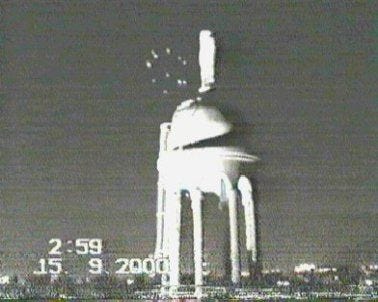
Beginning on August 17th, 2000 and ending in January of 2001,1 a glowing figure of the Virgin Mary similar to Zeitoun appeared above St. Mark’s Coptic Church in Assiut, Egypt. Like Zeitoun, this apparition was not continuous, was witnessed by thousands, was witnessed after the authorities shut off the lights of the surrounding area, and was photographed many times.
Warraq

On December 11th, 2009, an apparition of light appeared above the Virgin Mary and Archangel Michael Coptic Orthodox Church in Warraq al-Hadar, Egypt. The apparition appears to have only occurred in December, with the same intermittent apparitions, thousands of witnesses, and photographs. There is also at least one video of the event, which you can watch here. As far as I can tell, Warraq has slightly more skepticism around it than Zeitoun or Assiut. I will leave the explanation of that to Caleb Jackson.
The Catholic Response
There are two important features of all three of these apparitions I think are worth reflecting on:
The lack of message.
Independent reasons for the apparitions.
Lack of Message
Unlike Fatima, in which the apparition of the Virgin Mary communicated a very specific message (part of which included the conversion of Orthodox Christians to Catholicism), no message was ever communicated by any of these apparitions. One exception possibly exists for Zeitoun. According to secondary sources, the pastor of St. Mary’s revealed on his deathbed that the Virgin had appeared to him prior to the apparition. The recorded message mentioned by these secondary sources was “Be ready!” Obviously, this message has no doctrinal content.
Given that there is no doctrinal content revealed by the apparition herself, we are left with only what can be ascertained by the facts of each apparition. In my view, these apparitions would give some credence to the doctrines about Mary taught by the apostolic churches, her personal holiness, her divine favor, and perhaps her bodily assumption. However, it is worth pointing out that many Muslims saw these miracles as consistent with Islam, so I am unsure how much can be truly said regarding what these miracles demonstrate.
That said, there is no message corresponding to “Catholics and Muslims should become Coptic Orthodox.” Without a corresponding message, there is no vindicatory aspect outside of whatever truths can be ascertained about the Virgin Mary.
Independent Reasons for the Apparition
With the lack of message established, we can begin to think about why God would perform such a miracle. If we can establish strong, doctrinally independent reasons for God to perform the miracle, then the “level of vindication” would seem to fall.
I argue that the primary independent reason was to protect Coptic Orthodox Christians in Egypt from Muslims. This can be seen in three case studies:
The 1960 Ben-Gurion letter forgery.
According to Amir Krispel:2
Following an unsuccessful initial encounter, Pope Cyril VI and President Nasser had an amiable meeting at the latter's private residence in October 1959. According to Maḥmūd Fawzī, thereafter the two met solely in Nasser's home, and his son Abd al-Hakim was cured of his disease following the Pope's prayers for his health. Their emerging close relationship became the target of a possible sabotage attempt in 1960, when a letter allegedly signed by Cyril addressed to Israel's Prime Minister David Ben-Gurion, wishing him victory and the drowning of his enemies in the Red Sea, was made public. The letter was probably fabricated by an excommunicated monk from Jerusalem, whom Fawzi claims to have been recruited by the Israeli Mossad. Cyril publicly disavowed the letter, stressing the Church's non-recognition of Israel, and President Nasser acknowledged the letter as an attempt to generate sectarian tensions in Egypt. Nevertheless, the episode did serve to suggest in some eyes a potential link between Israel and the Coptic minority, perhaps due to a certain religious affinity.
This occurred just prior to the Six-Day War in 1967, and was reflective of growing suspicions towards Copts in Egypt. While Egyptian President Nasser demonstrated commitment to the Copts, sectarianism was on the rise. It is hard to say what would have happened to the Copts after the Six-Day War had the Zeitoun apparition not unified the Christians and Muslims of Egypt and given them hope.
The Kosheh Massacres
In August of 1998, two Coptic Christians were murdered by Muslims. After this, there were severe persecutions of several Copts. In January of 2000, more violence was brought against the Copts. As Jason Brownlee from the Carnegie Endowment records:
In August 1998, security officials in the southern Egyptian town of Kosheh, Sohag governorate, had tortured hundreds of Copts while ostensibly investigating the murder of two other Copts … On January 1–2, 2000, Muslims from nearby towns and villages flocked to Kosheh in response to a scuffle between two merchants, one Copt, the other Muslim, the evening of December 31. Kosheh had a population of 35,000 at that time, the majority of them Copts. The assailants vandalized Coptic stores and homes and attacked the locals. Twenty people, all Copts, were killed before the Ministry of Interior intervened. Rather than bridging confessional cleavages, area police exacerbated them, conspicuously leaving the scene while the conflict escalated.
This all occurred just prior to the Assiut apparition. After the apparition, violence appears to have declined for a time.
The 2008 Cairo Church Riot
According to a DOJ document quoting a CSW press release:
On Sunday, 23 November [2008] the Coptic Church of St. Mary and Anba Abraam was attacked by a mob of thousands, who began by protesting outside the church’s newly constructed extension building. The protest soon degenerated into a riot that lasted until 4am the following morning. The crowd initially threw stones at the new church building, and as the violence escalated, bottles and gas canisters were launched at [the] church, despite the presence of Christians inside the building. Several people were wounded and the glass front of the St. Mary and Anba Abraam church building was completely destroyed in the attack. Video footage of the event shows protestors setting banners alight while chanting Islamic slogans. The violence ended after police reinforcements arrived to disperse the crowd.
This occurred just prior to Warraq, and is reflective of the sectarian violence which was going on at the time. The Copts were facing persecution that was quelled by the apparition.
In summary, we can conclude that all three of these apparitions promoted peace among the Coptic and Muslim populations in order to prevent more violence. It is important to note that it was the Copts in particular who were being persecuted, not just the Christians in general, so it makes sense that God would place the apparition on the Coptic Church in particular.
Confusion About Vindication?
Bayesing at the Moon has said:
If non-Catholics are far more likely to go to Hell, doing miracles that look, to the people experiencing them, like proof that God approves of specific other denominations instead of sticking to obviously Catholicism-vindicating miracles is unexpected. Therefore, I think there being miracles across many different denominations is at least some reason to believe no denomination is super more likely than the others to be saved, even if the Catholic miracles seem more specifically vindicatory.
In response, we need to remember that these apparitions are not, in and of themselves, vindicatory of Coptic Orthodoxy. This is plainly obvious from the fact that many Muslims saw the miracle and interpreted it within Islamic theology. It is also obvious from the principles of interpreting miracles within the Catholic system. The lack of clear, non-Catholic doctrinal content makes this unproblematic. All that can be established about Mary from the apparitions is consistent with the Catholic position about Mary. At worst, the apparitions are evidential chips towards Coptic Orthodoxy, but those chips are outweighed by the massive number of Catholic Marian apparitions and other miracles.
But what about the fact that many people could interpret this miracle as vindicatory? We can introduce the principle here that God could permit individuals to be mistaken about how much the miracle proves. Notice what I’m not saying: I’m not saying God sends false messages in his apparitions. But I am saying that God can allow individuals to err in their own application of reason when they interpret a miracle. Take, for instance, false prophets who speak in the name of pagan gods. Simply because an Israelite was deceived by a false prophet who did this does not refute the Old Covenant. The Old Covenant has specific instructions for interpreting true and false prophecy. It is not the fault of God that the Israelite failed to apply those principles correctly.
To summarize, God could work a miracle which he foresees will be misunderstood by a few people as long as he has adequate reasons for doing so. If God prevented the slaughter of thousands of Coptic Christians, then this would seem to be just, even if by our own fault we err in figuring out the doctrinal content of this miracle.
It is worth saying one more time that I do not believe this miracle, rightfully interpreted, is vindicatory of Coptic Orthodoxy. It seems clear that even if you were a 1970s Coptic with no knowledge of any other vindicatory miracles that you could figure this out by the simple fact that all these different religious traditions find it consistent with their worldview.
Conclusion
The apparitions of Zeitoun, Assiut, and Warraq are not vindicatory of Coptic Orthodoxy. Properly understood, they do not offer a serious internal critique of the argument for Catholicism from miracles. The density of documented Catholic apparitions and miracles with doctrinal content also strongly outweighs and disproves any other denominations’ claims to miracle exclusivity.
I couldn’t procure an official end date for this.
Krispel, A. (2026), The Coptic Church in the Aftermath of the Second Vatican Council: Theological or Tactical Anti-Judaism?. Modern Theology, 42: 667-685. https://doi.org/10.1111/moth.70099
One of the priests in the Zeitoun Church made a simple comparison between Fatima and Zeitoun and said that the appearance of the Virgin in Zeitoun did not feature any speech, so that people would not believe it was specific to the Coptic Orthodox Church, but instead for all
https://youtu.be/QkVwz5zxTjo?si=mrUDySdzrjlcd2Ww (23:30)
Bearing in mind that some bishops of the Church have previously declared that the Virgin did not truly appear except in Egypt, indicating the correctness of our Church specifically. And when a book containing non-Orthodox apparitions, such as Fatima and Lourdes, was presented to the Patriarch of the Church, he objected that the book includes non-Orthodox miracles, and one cannot guarantee their authenticity
I somehow only came across this article today, an interesting write-up. I don’t know if anyone else brought this up, but in 1970, after Nasser died, the Sadat Muslim-Coptic relations deteriorated pretty badly. In 1971-1972, there were 11 recorded sectarian incidents and in November of 1972, there was a burning of a Coptic religious facility and also several Coptic apartments. The 70s were quite rife with Islamist political influence and sectarian violence overall, with relations breaking down further between Sadat and Pope Shenouda III. The 80s might have been even worse. There was the Zawiya al-Hamara incident in 1981, Sadat detained more than 1,500 people and placed the Pope under house arrest until 1985. Once Mubarak took power, relations were somewhat better, but the Coptics still faced heavy discrimination as well as pushback on their church construction. So, to me, it’s rather unconvincing to claim that God’s motivation behind the apparitions was to unify the Coptics and Muslims when only 3-4 years after the first apparitions, there was substantial infighting again. Clearly these apparitions were not working if God had to perform a similar set of miracles three times just to temporarily ease Coptic and Muslim relations before they broke down again. Not one of these miracles was very effective.